
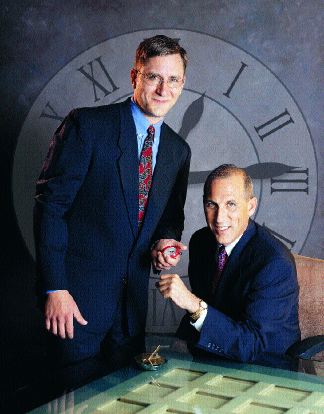
Bob Juracka, standing, and Doug Johnston, represent Applied Systems, which partnered with The Hartford to develop a standards-based small commercial real-time rating and issuance implementation for agents.
 echnology forecaster and strategist Daniel Burrus declared during his general session presentation at the ACORD Technology Conference '99 that, "time is the currency of the new economy." It's a new slant on the old adage, time is money. But in light of a recent announcement by Applied Systems and The Hartford Financial Services Group, Inc., the insurance industry can now leverage time with technology and in doing so, can eliminate the speed limits that "batch, store and forward" technology imposes. Data can now travel at "warp" speed.
Warp, in this context, isn't the speed at which the characters of "Star Trek" travel. It's an Internet-based data transport product developed by Applied Systems, a provider of automation software, systems and services to the independent property/casualty market. This data transport mechanism links the agency and the company together to enable a seamless business-to-business transaction using the Internet as the backbone.
But traveling at warp speed isn't enough. You need to have a destination. In this case it's The Hartford, which is able to integrate into its legacy systems data coming from a variety of external systems, providing real-time processing.
 Independent agents today spend a significant amount of time waiting for commercial policies to be rated and issued. But in the area of small commercial, "touching" the account numerous times erodes the already slim profit margins even more. Consider this typical scenario: the agency enters the data into its agency management system, submits the quote request, issues a binder, prepares the binder billing, then reverses the binder billing once the policy is received and finally issues the invoice for the actual premium. All these "touches" cost money--and time.
However, the waiting game may be over, thanks to the efforts of Applied and The Hartford. These two long-time interface partners, using the latest technologies: ACORD ObjX, XML, WinDNAfs and the Internet, demonstrated "real-time insurance" at the ACORD Conference. Three screens depicted the agency desktop and the carrier mainframe quote and issuance system. WinTAM was on one screen, Vision on another, and the Hartford stag--its Spectrum BOP system--on the third. But you had to watch closely. To fully appreciate the real-time rating and issuance of a complete multiline businessowners policy, you couldn't blink. Once the "rate" request was submitted, it took a scant two seconds for a Hartford Spectrum (BOP) policy to be rated and for the rate to be back at the agency desktop. It didn't matter whether the transaction was initiated in WinTAM or Vision. Another keystroke activated the printer and the policy was generated on the spot.
Kevin Kelly, worldwide insurance industry manager, Microsoft Corporation, observes that the real-time policy issuance experience is a necessary departure from the batch business/data processing environment that's been a part of the insurance industry for so long. Such "instant gratification will be necessary to satisfy consumer demand moving forward," he maintains. "And today we are not prepared as an industry to do so with the incumbent technology that's in place."
Doug Johnston, vice president, company products division for Applied Systems, says the Internet and these latest developments make it possible for the insurance industry to take giant strides in efficiency and timesaving. "The Internet provides the network connection between the agency's existing software system and the company's existing software, allowing real-time data sharing and processing in one seamless session. This allows both the agency and the company to work within their own native software systems without directly 'seeing' the other party's system. And with the push of a button, the agency can have the data it has entered processed-rated, underwritten and turned into a policy--by Hartford's computer system--all behind the scenes."
Johnston emphasizes that Warp is able to take data from any user interface and put it into the correct format for whoever is receiving it. If a transaction begins in WinTAM or Vision, for example, Warp allows that program to become a "client" to the business rules at the company.
 Hartford's Hugh Anderson is enterprise architect for commercial lines electronic marketing. He explains that once the agency enters the data onto ACORD forms in the agency management system, a few extra pieces of information would be needed to quote a Spectrum policy. Those "company-unique" elements would be pushed down to the agency from the company in much the same way as they are in a batch upload session. The difference in this case is, it's happening instantaneously. "Instead of queuing to a mailbox and getting transmitted overnight or whenever the agency dials out, there's an Internet line that's open all the time. This transmission is immediately made to the company system and the rating is passed back to the agency."
Anderson says this real-time technology is the next logical step, both in terms of a business workflow and technology. But perhaps most important, it's a standards-based implementation. "What Applied has developed is non-proprietary. They can offer this to carriers that do the same thing we did," he notes. "On the other side, what The Hartford has developed is non-proprietary. We're ready and willing to work with other vendors that can provide the same kind of capability on their end. So it still follows the industry-based single entry, multiple company interface model."
 Joe Gauches, senior vice president of electronic marketing and commerce for The Hartford, says this technology leverages the partnership concept that's supposed to exist between agencies and companies. "We're providing our agency partners with the tools to make the sale, and service the customer. At the same time we're retaining the control we need, and we're doing it in a way that doesn't encumber the process."
 Should there be underwriting concerns, the real-time interface allows the agency and company to have access to the same information at the same time. Applied Systems' Bob Juracka, senior vice president and national sales manager, notes that a carrier's smart underwriting system enables a "hands off" treatment of a standard submission--allowing the technology that's already built into the system to do its job. Human underwriters can then focus on the exceptions. The real-time interface, he says, "leverages the best of everything that's available from transport, to common languages such as XML, to the Internet as the wire, even contemplating legacy systems on the back end."
And unlike batch mode transactions where you're informed there's an error, but you aren't told what it is, a real-time session gives you precise information about invalid data values. You remedy the information and resubmit. Should the agency request that the policy be issued, that can be accomplished in the same online session. And if the submission simply doesn't fit the Hartford guidelines, that information is passed back to the agency in real-time also.
Juracka emphasizes the accuracy of the quote, noting that the request goes directly into the carrier's rating system. "The quote the agency gets back isn't off $15 or 15 cents. It's the actual premium." And if the customer accepts the agent's proposal, the agent clicks the "issue" button and the policy is generated immediately, squeezing weeks out of the process.
But independent agents do represent more than one company. Juracka points out that the agency can utilize its comparative rating at the same time a real-time session is going on so customers and prospects still have options. However, he notes, the quote from the comparative rater won't be as accurate as the real-time quote, because the real-time quote came off the company's system.
Gauches says the real-time capability is vital in the small commercial arena where there's high volume, low premium transactions. "The driver becomes profitability," he observes. "We need to get an accurate contract to the customer in the quickest amount of time. This real-time technology provides the clearest benefit to the agency and the company."
In discussions about the real-time capabilities with agent focus groups, Gauches says it's a split decision as to whether agents prefer to issue the policy in their offices or continue to have the company process the policy. In this real-time environment, immediate issuance is available. However, where printing is concerned, agency technology is still an issue. Printing out a 20- to 60-page policy on a local laser printer may not be a "best practice" or desirable for agents, he maintains. The Hartford has the technology to print these policies in a high speed, high volume scenario. The agency has the option of printing a declarations page and a listing of the applicable attachments for its file and The Hartford can still produce the policy and forward it to the customer.
 "The Internet and these latest developments make it possible for the insurance industry to take giant strides in efficiency and timesaving."
--Doug Johnston, Vice President, Company Products Division, Applied Systems.
For agencies, any user of WinTAM 6.0 or better or a Vision user can achieve real-time insurance once the carrier has the Warp technology in place. "It's no more complicated than loading a set of company-unique edits," Juracka explains. The rules "live" at the company and are pushed down to the agency when the transaction is occurring.
Vendors and carriers have long labored under protracted development periods. But with this technology, including Objects technology, development time was compacted to approximately 10 weeks. "With the proof of concept demonstrated at the ACORD Conference, Hartford pilots are expected to go live in the fourth quarter of this year," according to Joe Gauches. In this same timeframe, commercial auto and workers comp quote and issue will be added to The Hartford's menu of real-time capabilities.
The Hartford and Applied Systems have been yeomen in the field of interface, each making the necessary investments continuously. So when one was ready to take another important step in the interface process, the other also was ready in short order. Hugh Anderson points out that The Hartford and Applied Systems partnered to achieve "the first true commercial lines SEMCI" in 1997. Earlier this year, they joined in discussions of real-time transactions. Technology was bringing about evolution in the SEMCI effort. "This real-time technology leverages Microsoft's technology and the work done to date with ACORD ObjX. It's a standards-based implementation of the next generation of insurance technology," he notes.
Doug Johnston says Applied is working on additional technologies that would allow Warp to integrate with a company's existing mainframe. "It would be a 'black box' technology that could be plugged into just about any insurance company's existing mainframe system to enable real-time transactions. Applied wants to be the transport. We want to provide the technology that links agencies and companies together."
Hugh Anderson explains The Hartford's technology is also capable of working with other vendors--even Internet shopping malls. "This is not a proprietary implementation," he says. "We're working with Microsoft's DNAfs, we're leveraging ACORD ObjX, we're using an XML-based implementation and we're using an Internet protocol. We've taken SEMCI to the world of the Internet. Therefore, any vendor can get on board and any other carrier can get on board. This is a new operating model that gives the insurance industry something to strive for."
With the ubiquity of the Internet and the readily achievable standards that come with it, Joe Gauches predicts that technology will gradually become less of a driver--that the playing field will become more level. "It will be the equivalent of picking up the phone," he suggests. "Today it doesn't matter whether I'm using MCI, Sprint or AT&T or whether I'm making a long distance, local or cellular call. I get clear communication quickly. Insurance technology is heading in the same direction."
Doug Johnston concludes, "Everyone has been predicting the Internet will bring about the death of the independent agent. When you look at the Warp technology, you see the agent is the most important part of the insurance transaction. This capability is about more than transporting data from one system to another. It's a radical change in the way we write insurance. Being able to do it at such a low cost makes the independent agent the most efficient means of doing business. This can make the independent agent a real-time distributor of business." *
©COPYRIGHT: The Rough Notes Magazine, 1999