BRITISH INSURERS FEEL TREMOR
FROM TERRORIST ATTACKS
What happens across the Pond has a filter-down
effect on American insurance industry
By Phil Zinkewicz
One thing that cannot be denied in all this is that insurance rates for most buyers of insurance are bound to go up considerably.
 Phil Zinkewicz has been covering the international insurance scene for more than 25 years. He has made frequent trips to London, interviewing executives at Lloyd's as well as the non-Lloyd's market. His most recent visit to London was in the aftermath of the World Trade Center attacks. Here's what he found.
Too often, participants in the United States insurance industry suffer from tunnel vision. Claims representatives tend to stay in their own little worlds, as do underwriters. This isolation is particularly true of independent agents and brokers. Small and even medium-sized agencies concentrate on their immediate insurance markets--the primary companies--and do not closely follow developments in the international insurance and reinsurance arenas. To some extent, this is understandable. Independent agents have to satisfy Main Street America and Main Street America doesn't want to know what's happening at Lloyd's of London.
The fact is, however, that they do need to know what's happening overseas because of the "filter- down" effects on primary markets in the United States. The World Trade Center terrorist attacks demonstrate this very clearly. When the twin towers tumbled, shock waves reverberated throughout the global financial services sectors. Before the incident, insurance executives were predicting a "slight hardening" of the property/casualty insurance marketplace in the United States. Now, in London, executives are predicting a retrenchment of the reinsurance business unlike any known since the mid-'80s and that's going to mean severe market conditions for the rank and file in the United States.
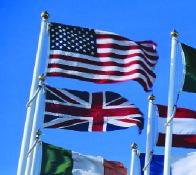
Politically and emotionally, the British are one hundred percent on an equal footing with America in these terrible times. In his rousing address to the Labor Conference in London, British Prime Minister Tony Blair not only set the tone for the long-term united front that the U.S. and the U.K. are taking against terrorism, but he also reflected the views of the people on the streets of England. "I've never seen so many American flags," said one taxi driver in Brighton. Said another taxi driver: "Well, we're in it together again. Together, we beat Hitler and we'll beat this guy."
Patriotism aside, however, the view from London in terms of economic repercussions and especially repercussions in the financial services sector is bleak. Newspaper reports and analysts' predictions tell of a financial services marketplace that will see black ink turning to red and jobs lost at an amazing pace in the areas of banking, securities and insurance immediately and in the coming years. This will be particularly true in the insurance sector, where the losses resulting from the World Trade Center terrorist attacks will be multi-billions of dollars. The effects will filter down to insurance industry segments all over the world, most particularly the United States, where the British insurance industry is most active.
Lloyd's of London, trying desperately to re-establish itself as a premier insurance and reinsurance marketplace following years of costly litigation over investor lawsuits, could be facing up to £7 billion in gross liabilities, according to Fitch, a London ratings agency. Lloyd's itself has said that it faces up to £1.3 billion--the biggest single loss in the market's history--but that was net of reinsurance it will be entitled to collect. Fitch said that Lloyd's net loss is likely to be at least £1.7 billion because history has shown that initial estimates of the cost of large catastrophes always are understated. Fitch said that, after consulting with clients, Lloyd's gross exposure is likely to be three or four times the net figure.
Said Fitch: "Insured losses from the Northridge earthquake, which occurred in January 1994, were initially projected by the industry at $2.5 billion one month after the event, but deteriorated over time so that by September 1995, final estimates were placed at $12.5 billion." The rating agency said that, given the magnitude of the World Trade Center event, it is not out of the question that insolvencies might result. But Lloyd's itself says that 90% of its reinsurance is with companies with a credit rating of "A" or better, and it is confident it will recover the reinsurance due.
However, Fitch countered that those reinsurers might have those credit ratings now, but it is less certain that they will have those same credit ratings in six to nine months when it becomes time to collect.
The non-Lloyd's insurance market is understandably concerned about losses from the World Trade Center disaster as well. Estimates of losses keep climbing every day. Zurich Financial Services raised its estimates of losses from $400 million just a week after the World Trade Center attack to between $700 billion to $900 billion a few weeks later. Goldman Sachs has reduced its 2001-2003 earnings forecast for the entire European insurance sector to reflect the changed environment in the aftermath of September 11. "The estimated changes not only reflect the direct claims costs but also the lower levels of investment gains, reduced fee levels in life and asset management and slower life sales," says the U.S. investment banking firm.
Lloyd's and other large European insurers are understandably having a difficult time with estimates of losses because of the complexity of the policies out there. One of the things to be considered, according to European insurers, is whether the events of September 11 were a "single" or "multiple" event. In other words, were the attacks on the World Trade Center and the Pentagon one event, because they were obviously planned that way, or were they separate attacks because they did not occur simultaneously? Almost all insurance policies have a ceiling on their maximum payout in the event of a loss. If the events are seen as a single loss, the cost will be greater than the insured portion of the loss, so a great deal of the losses will go uninsured.
If, however, they are seen as several separate incidents, insurers will have to reach their maximum payouts on each, greatly increasing the cost of the total payout. In addition, European insurers are looking at payouts resulting from cancellation of sporting and entertainment events, such as the Emmy Awards. These cancellations were certainly the result of the attacks, but the decisions to cancel were voluntary. Will insurers bear the burden of losses, or will they argue that the cancellations were deliberately caused and therefore not insured? These arguments will certainly take place between insurers and their reinsurers as well as in U.S. courts, European insurers believe.
One thing that cannot be denied in all this is that insurance rates for most buyers of insurance are bound to go up considerably. Jardine Lloyd Thompson, Britain's largest insurance broker, says that some businesses could face bankruptcy because of soaring commercial insurance premiums. The company says that the cost of some coverages, particularly employers liability insurance, could rise so high that commercial firms will not be able to afford the premiums. Jardine reports that some commercial insurers already have withdrawn from the business.
Ironically, a Pakistani delegation has visited Lloyd's of London complaining that "punitive" insurance rates that were levied on freight shipments from Pakistan have risen to very high levels in the aftermath of the World Trade Center attacks. Other countries such as Istanbul are looking to their own governments to take on the business that had been going to Lloyd's.
So, while England, its business sectors and most of its people are on the side of the United States in the battle against terrorism, financial services industries in the U.K. are also terribly concerned about their future.
Independent agents should be following these developments closely so that they can explain to their clients how their rates are being affected. *