RISK PROBLEMS/SOLUTIONS
Loss examples help buyers visualize the exposure
By Leroy H. Utschig, CPCU, ARM
Proper file documentation is always a vital part of defending
any insurance agent when a client makes the allegation(s)
that the agent did not do his or her job properly.
During the late 1990s, there was a serious auto accident in northwestern Wisconsin. A young lady in her early 20s was seriously injured and, as a result, became a quadriplegic. The at-fault driver of the other car had statutory bodily injury liability limits of $25,000.
Shortly before the accident, the young lady had moved from Minnesota to Wisconsin. While in Minnesota, she had underinsured motorist limits of $300,000. When the contract was rewritten to reflect that she lived in Wisconsin, the underinsured motorist limits were changed to $25,000. For $6 additional premium, she could have had UM limits of $300,000. However, the agent never offered her underinsured motorist limits beyond the statutorily set $25,0000 minimum.
The young lady sued to have the court change her UM limits to the $300,000 she had prior to moving to Wisconsin. Her insurance agent did not have any file documentation to demonstrate that there had been a discussion of underinsured motorist limits. As little as a one-half sentence note regarding such a conversation with the insured would have been of benefit in defending the agent.
Another actual loss involved a fire in an old building with very bad housekeeping. There was no insurance on the property, because none of the local insurance agents' insurance companies would insure it. The property was insurable through the Wisconsin Insurance Plan ("Assigned Risk" type of plan sponsored by Wisconsin's entire insurance industry).
The Wisconsin Insurance Plan (WIP) has been in operation since the early 1970s. Periodically, in a bulletin sent from the Office of the Commissioner of Insurance (OCI) to every insurance agent in the state, the OCI will discuss the Wisconsin Insurance Plan. Despite this, the agent acknowledged that he did not even know about the WIP. A significant fact of the errors and omissions claim was that the agent did not have any file documentation regarding offering the Wisconsin Insurance Plan program as a way to insure the property.
Proper file documentation is always a vital part of defending any insurance agent when a client makes the allegation(s) that the agent did not do his or her job properly. Ideally, an agency would have a recording of every conversation with all of its clients; however, this idea is simply impractical. Nevertheless, it is possible to have some record of the results of conversations between an agent and his or her clients. One way of recording the decisions on coverages is by using a coverage checklist. I have seen many examples put out by various sources--insurers and advisory services. The typical checklist is 35 - 50 pages long.
Only once in 40 years have I seen anyone use one of these long checklists, and in that instance the owner of the insurance agency skipped about 95% of the items on the list. The usual place where I have found these checklists is on an agent's shelf--in pristine condition! Although these checklists are very good, it takes a lot of a client's time to complete such a form. What would be the result of your going into a client or a prospect and saying, "I have this 35-page questionnaire that we are going to complete. It should not take more than a couple of hours."
Many policyholders will refuse to help an agent complete such a document. My suggestion is a two-page, letter-sized checklist. Mine contained nearly 140 coverages, listed sideways in three columns. The "paper" was a light cardboard that would easily fold to look like a sheet of letter paper ready to be put into a "number ten" envelope.
This checklist was completed for each account every year. It was reviewed at the time the agent delivered the renewal contracts to the client. All exposures that were already insured were marked off. Thus, the agent needed to ask comparatively few questions regarding possible uninsured exposures.
An actual example demonstrates the value of using a checklist. The client was an insulation contractor whose building was an old, steel Quonset hut. It looked more like an abandoned building than the main location for a business. By some standards, the business was successful. Insured through an insurer's national association program, it paid its $35,000 per-year premium on time and its workers compensation experience modification was around .75. A good agent had been handling its insurance for many years.
At renewal time, the agent was going through the coverage checklist with the business owner. One of the items was fine arts. The agent said, "I don't think that you have any fine arts to insure."
When the client asked what was meant by fine arts, the agent replied, "An example could be the paintings you have hanging on your walls. If they were valuable, we would specifically insure them on a fine arts form."
This agent was more than surprised when the business owner told him to insure the paintings for $250,000. Without the use of the checklist, the agent might never have determined that the paintings should have been specifically insured.
For each coverage listed on the checklist, an agent can check what applies to a given client. Here is a typical setup:
Needs Has Refused Coverages
* * * Fine Arts
It is easy to ask the client about a specific coverage. As you ask about potential losses, clients will ask questions about the various coverages. You should be able to explain and discuss every coverage on the checklist. Typically, a short statement or two is all that is needed. An adequate statement might be, "Fine arts will cover the painting on an all-risk, agreed-value basis."
A checklist will be organized into major coverage areas, for example, property, general liability, automobile, workers compensation, inland marine and crime. If a checklist were to include every available coverage, it would be too long to be manageable. For example, for crime coverages, use just three. Presume that the client has "risks of direct physical loss including theft" covering its business personal property. Embezzlement, forgery and theft, disappearance and destruction will round out a client's crime coverage protection. While there may be a dozen or more other coverages, none of them provides any protection that is not included by the crime coverages listed.
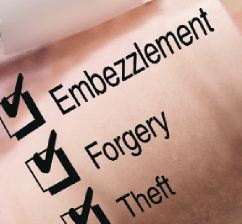
Here is an example of the crime section of a coverage checklist.
CRIME
Needs Has Refused
* * * Embezzlement
* * * Forgery
* * * Theft, Disappearance Destruction
Start with a brief explanation
for each of the needed coverages. A more detailed explanation should be used only for the client who is asking questions.
Listed below are sample explanations for the three crime coverages mentioned above. An agent can create his or her own way of describing these coverages. The suggested wordings given here are to serve as a catalyst to help in developing a personal explanation of these coverages.
Embezzlement
"Embezzlement pays in the situation(s) where employees steal from their employer."
When explaining embezzlement coverage, it is always more effective if an agent can cite some embezzlement losses that happened locally. Such losses are reported in newspapers on a regular basis. Here are some examples of actual losses:
* A church trustee, who was a treasurer of the high school band parents association and a school bus driver, embezzled more than $40,000 from his church.
* An employee of a trucking firm embezzled so much money from his employer that the firm was forced to file bankruptcy.
Forgery
"Forgery covers losses caused by someone issuing unauthorized instruments (checks). It also covers the alteration of outgoing instruments. Forgery and embezzlement are very closely related. Many times an embezzler will use checks as a way to get money from his or her employer."
Here is an example of an actual loss:
* A woman who was working in the bookkeeping department of a hardware store had a boyfriend who worked for one of the store's suppliers. Her boyfriend would send her invoices for goods that were never shipped. She would then issue checks for the unsent goods. The boyfriend would intercept these checks, cash them and the two of them would spend the money.
Some claims people would deny this as an embezzlement loss, stating that it is a depositor's forgery loss. Other claims people would deny it as a depositor's forgery loss stating that it is an embezzlement loss. Embezzlement and depositor's forgery coverages are very closely related. In fact, that is why the depositor's forgery premium is based on a percentage of the embezzlement premium.
By carrying both depositor's forgery and embezzlement coverage, the insured will be protected whether the loss is classified as embezzlement or depositor's forgery.
Theft, disappearance and destruction
"This coverage protects against the loss of money and securities."
One loss example involves a business owner who put $10,000 in a folder in a file cabinet next to his Class E safe. (A Class E safe has a burglary resistance rating close to that of a bank vault.) The business owner did not put the money in the safe because he figured that is where the criminal would look for the money. A thief took the $10,000. Because there was no evidence that an employee took the money, this type of a loss would be covered by a theft, disappearance and destruction contract.
Among the losses covered by theft, disappearance and destruction are holdup, robbery, safe burglary, windstorm (a tornado blows away the money) flood, earthquake, and fire.
Summary
Good file documentation can be very useful in preventing or defending an insurance agent's errors and omissions claim. A coverage checklist can be a part of an agent's file documentation. In the next issue(s) we will include more items for our suggested coverage checklist. *
 The author
LeRoy H. Utschig, CPCU, ARM, is a Wisconsin-based insurance educator, consultant and expert witness.