 "Are you a PIG or a HAWG?" Rick Bauman asks attendees. (PIG = Phenomenal Income Growth; HAWG = Hysterical Activity on the Way to the Grave.)
Top Canadian brokers reach for the sky at their
first annual Dare to Soar meeting
By Elisabeth Boone, CPCU
"Are you a PIG or a HAWG?" Rick Bauman asks attendees. (PIG = Phenomenal Income Growth; HAWG = Hysterical Activity on the Way to the Grave.)
When you walk into a room filled with top producers, you can feel the energy pulsating like an electric current. That's just what happened at the first annual Dare to Soar meeting for Canadian brokers, which was held in mid-October at the magnificent Niagara on the Lake resort outside Toronto. Hosted by Rick Bauman of Bauman Consulting, Inc., and co-sponsored by Rough Notes magazine, the two-day conference drew almost 30 attendees from Canada, plus some star performers from the United States. Adding even more zest to the proceedings was agency growth guru Roger Sitkins, the revered "coach" for select leading U.S. agencies, who seems to inhabit his own energy-generating plant.
Rick Bauman, whose consulting firm's trademarked tagline is "The Broker Profit Builders," was an amiable and able host, firing off his favorite power acronyms (MUD = Monkey Up Delegation; CRAP = Can't Resist Attracting Paper) and keeping attendees' eyes on the prize: practicing the behaviors that build profits.
Holding up a plump (but not live) porker, Bauman asked: "Are you a PIG or a HAWG?" In Bauman-speak, PIG stands for Phenomenal Income Growth, whereas HAWG is short for Hysterical Activity on the Way to the Grave. Those who aspire to be profit-building PIGs, he cautioned, must eschew all forms of HAWG behavior. "To truly 'soar,' you have to make a choice," he asserted.
Building profits, Bauman emphasized, is a step-by-step process that requires awareness, focus, and a top-down commitment to change at all levels of the organization. Those steps are the components of The Profit Builder Solution(TM) , and they formed the nucleus of the two-day program. The steps can be summarized as:
* Assess the current situation
* Create a vision
* Identify obstacles
* Develop strategies
* Design a plan to build profits
* Create a scorecard
* Assemble the profit-building team
* Launch the plan
* Conduct regular progress reviews
* Determine the return on investment in training
* Adjust the plan as required.
In The Profit Builder Solution, Bauman explained, management assesses the agency's current situation by completing a Sales Performance Scorecard(TM). This instrument measures each producer's results to determine where he or she falls on a continuum from low performance to high performance. In identifying obstacles to peak sales performance, Bauman said, management should ask, "What keeps our good account executives from Soaring?" Among the performance barriers producers often voice are:
* "I'm not having as much fun anymore."
* "I'm not making as much money as I want."
* "I'm tired of having my good accounts under attack."
* "I don't have enough time to sell."
* "I don't have enough quality prospects."
* "I'm tired of being compared on price all the time."
* "I need a system to follow."
* "My closing ratio isn't high enough."
To break through these barriers, Bauman said, a powerful tool is Roger Sitkins' trademarked "Ten Great Plays." The Ten Great Plays focus on segmenting the agency's business by revenue per account and providing the appropriate level of service to each segment. The Plays also address value-added services, client relationship management, solutions-oriented selling and servicing, and trusted adviser marketing.
Vertical growth: getting out of crisis mode
In a presentation titled "Vertical Growth: The New Beginning," Jeff Steele, senior vice president and partner of Phoenix Group of Insurance Brokers in Edmonton, Alberta, explained how his firm uses The Ten Great Plays in shaping its own vertical growth strategy. The Phoenix Group knew it had "hit the horizontal wall," Steele said, when it (a) reached a growth plateau, (b) found itself trying to be all things to all people, (c) was using staff resources in the wrong places, and (d) was stuck in a reactive, crisis-managing mode.
By focusing on time management and using the Ten Great Plays, Steele said, his firm was able to emerge from a wheel-spinning crisis mode and devote its resources to profit-building activities like relationship building, recognizing new opportunities, and planning instead of reacting.
 A vertical growth strategy moved Jeff Steele's firm from crisis mode to profit building.
In planning and implementing a vertical growth strategy, Steele said, he learned some key precepts that he calls his "Resolutions for Success":
1. Set goals.
2. Focus.
3. Fire bad clients.
4. Diversify and expand your business.
5. Keep your clients happy.
6. Partner up.
7. Solve real problems.
8. Remember cash is king.
9. Reflect.
10. Have fun.
The 1%er's Story
Next up was "Coach" Roger Sitkins, who outlined the evolution of his 1%er's Network, which originally was his private client group. These agency principals, he said, make a total commitment to work "on" their business vs. "in" their business: instead of getting caught up in daily minutiae, they delegate appropriately, and each week they spend a day out of the office to think about their business from a macro rather than a micro perspective.
Members of the 1%ers Network, Sitkins said, never "graduate"; they know they always have more to learn. They constantly communicate their vision, and they focus on behaviors, not numbers. Echoing a favorite exhortation, he said, "It really is okay for your success to be easy." His 1%ers "realize things can be either easy or hard. They look for the E-Z. What about you?"
Sharing the experience of a 1%er in action was Sitkins client Chris McVicker, president and CEO of the Flanders Group in Rochester, New York. Being a 1%er, McVicker emphasized, requires commitment, discipline, and sometimes even playing the "bad guy." Some of the "power tools" used at the Flanders Group are:
* Exhaustive personality and aptitude testing of producer candidates
* The "lifeboat drill," which ranks each employee in terms of current performance value and potential future value to determine the employee's importance to the agency
* Testimonials from satisfied clients
* Client/prospect/company relationship management ("Relationship is king")
* Regular and frequent review of each producer's critical indicators of performance vs. goals: proposals, sales, closing ratio, gross commission, average commission, referrals; sold referrals; accounts written; and accounts not written.
There's a fine line between attention to detail and obsession with it, and McVicker's success as an agency principal and a 1%er clearly reflect his ability to make that crucial distinction.
Becoming a trusted adviser
For agencies and brokerages that truly want to take their business to the next level, the days of selling off-the-shelf products at the lowest price are ancient history. The agencies that succeed in today's sophisticated market have made the critical transition from being vendors to becoming trusted advisers, comparable to their client's accountant, lawyer, banker, and financial planner.
Making this transition sometimes requires making difficult choices, said Barry Brownlow of Brownlow & Associates, Ancaster, Ontario. In a presentation titled "Getting on the Trusted Adviser Team: Observations from an Accountant Who Became a Trusted Business Adviser," he explained that his firm made the unpopular decision to eliminate certain clients and focus its energy on building trust with clients who value the firm's specialized services. The goal of Brownlow & Associates is to be a one-stop shop, providing not just insurance products and services but also personal wealth and asset management.
In deciding whether to let go of a client, Brownlow said, his firm applies the "three-level test":
Level 1: You don't want to pay our fees.
Level 2: You don't respect our opinion and/or you don't like our people.
Level 3: You don't want to buy the other services that you really need from us.
Becoming your clients' trusted adviser isn't a one-sided proposition, Brownlow asserted. Instead of guessing what top clients want, he says, "Help your clients change your firm." How?
* Choose the clients you will treat as friends
* Use a standard process to listen to those clients/friends
--Questions that promote dialogue
--Questions that demonstrate expertise
--Questions that define the relationship
* Manage your employees' reaction to this information
--Document and share questions and answers
--Discuss relationship and sales measures
--Deliver new products from solutions to common problems
 "If you continue to focus on products as a differentiator, you are doomed."
--Bob Phelan
Relationships first
The opening act for Day 2 of Dare to Soar - Canada was Bill Bishop of Bishop Information Group in Toronto, who shared with attendees the elements of The Relationship-First Formula(TM). "Everyone wants more customers and more money," he said. "What's stopping us?" Many business owners fall into The Product-First Trap(TM) because they use The Product-First Formula(TM):
Product (P) x Large Number (LN) = $uccess ($)
Firms that find themselves in The Product-First Trap, Bishop said:
* Keep fine tuning their product/service
* Serve many different kinds of customers
* Focus first on selling their product
* Are obsessed with competition
* Don't know their customer's goals
* Have thin, falling margins
* Are always looking for new customers
* Engage in fragmented thinking and activities.
"To escape from The Product-First Trap, you may need to change your business model," Bishop said. His recommendation? The Relationship-First Formula:
Quality Relationships (QR) x Unique Value (UV) = $uccess ($)
The benefits of using this formula, Bishop said, are:
* Greater focus of strategy/action
* Become customer type experts
* More ways to make money
* Greater flexibility, more security
* Enhanced customer loyalty
* More unique position in market
* Higher margins
* Unified tools and systems.
Building relationships based on unique value instead of selling products to anyone who will buy them, Bishop observed, translates directly into more of the right kind of customers and more money.
Fortune 500 Services
Companies in the Fortune 500 expect, and receive, insurance brokerage services appropriate to their status. Is it possible, even affordable, to provide this level of service to middle market clients?
For Bob Phelan of Litchfield Insurance Group in Torrington, Connecticut, the answer is an unqualified "Yes." In his presentation, "Providing Fortune 500-Type Services to the Middle Market: How To Stand Out in a Crowd of Look-Alike Brokers," Phelan said brokers that want to differentiate themselves must engage in "value migration," leaving behind the old values of price, transaction, and commodity and embracing the new values of TCOR (total cost of risk), solution, and value-added services. The elements of TCOR are:
* Insurance premiums
* Retained losses
* Internal administration
* Outside services
* Financial guarantees
* Fees and taxes.
For insurance brokerages, just as for manufacturing firms, there's a clear trend toward deriving more income from services than from the sale of products, Phelan pointed out. "Insurance is the commodity in our business like computers are becoming the commodity in the information technology business," he commented. "If you continue to focus on products as a differentiator, you are doomed."
Risk management, Phelan said, "is a process supported by value-added services. Services based on knowledge, ideas, and innovation are the only measure of long-term value to the customer." To stand out from the crowd, he said, a brokerage must apply "fanatical focus":
* You must position yourself in your prospect's mind.
* Your position should be singular: one simple message.
* Your position must set you apart from your competitors.
* You must sacrifice. You cannot be all things to all people; you must focus on one thing.
 "Assume you will get the sale; build it into your presentation."
--Andy Sloan
Among the Fortune 500-type services a brokerage can offer its mid-market clients, Phelan said, are alternative risk transfer, claims management, human resource consulting, safety consulting, benefits consulting, legal services, and special products. Special services might include international products, online benefits administration, network security consulting, substance abuse consulting, online customer service, and disaster planning. Some of the newest ideas in services, he continued, are Kolbe personality profiling, actuarial services, disease management, workplace violence consulting, executive security consulting, and regulatory compliance audits.
How can brokers create Fortune 500-type services? Phelan recommended:
* Outsource. (Example: Nike doesn't make anything. They design and market. Everything else is outsourced to experts.)
* Use your carriers.
* Use your wholesalers.
* Create services in-house.
* Become a reseller.
The time to implement these strategies, Phelan asserted, is now. "Major brokers (national and regional) have these resources,
and they are chasing your best accounts," he said. "All service
firms must migrate to a VAS (value-added services) strategy." And finally: "Do you have another strategy to protect your 'A' accounts?"
Full BOR Marketing
With the same energy and enthusiasm he displayed throughout the two-day Dare to Soar session, Rick Bauman shared the elements of his Full BOR Marketing(TM) strategy. First let's decode that acronym; BOR stands for Broker of Record. Like Sitkins, Bauman holds firmly to the conviction that an agency or brokerage should obtain as many of its new accounts as possible on a broker of record letter. The question principals should ask themselves, Bauman said, is: "If I'm not getting a broker of record letter, why am I working? Is it just about price?"
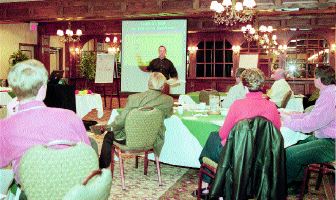 Bob Phelan of Litchfield Insurance Group tells attendees how they can provide Fortune 500 services to their mid-market clients.
When meeting with a prospect, Bauman advised, conduct a four-point checkup by asking these questions:
1. Is it the right coverage?
2. Is it the right price?
3. Is it the right insurer?
4. Is it the right agent or broker?
The answers to the first three questions may all be "Yes"; your challenge then is to show the prospect why the answer to Question 4 is "No." To prove you're the right broker, Bauman said, ask the prospect "spear" questions to elicit weak spots in the incumbent broker's services. This sets the stage for you to present a value-added service that addresses that weakness. In effect, the prospect virtually talks him- or herself into giving you a broker of record letter.
Attesting to the power of Full-BOR Marketing was Andy Sloan of Vince Tomenson Dickerson Insurance Brokers, Oakville, Ontario. In a presentation titled "Product Vendor to BOR," Sloan emphasized the importance of keeping the focus on the kinds of services the client wants. A client's issues with the incumbent broker are rarely about coverage or insurer; they're usually about services, he remarked. Clients want to believe and trust their broker, Sloan continued. "Be honest. Give them all the information. Make processes transparent."
"We ask prospects where they want to be," Sloan said. "Their opinion is the one that matters." His firm's producers ask a prospect:
* What do you want from your program?
* What do you want the solution to be?
* How do you want us to deliver the solution?
* Here is what we propose to do; is it right for you?
Sloan concluded by offering some valuable advice to producers: "Understand that the sale is made way before the presentation. Don't make your pitch until the result
is inevitable. Confidence is imperative; rehearse. Assume you will get the sale; build it into your presentation."
Brokers: speak up!
Elaborating on the theme of winning accounts on value-added services rather than price was Michel Drouin of Charlesbois Trepanier & Associates in Hull, Province of Quebec. In a presentation titled "Customers Can't Hear What Brokers Don't Say!" Drouin took note of direct writers' increasing share of the Canadian personal lines market, where independent brokers traditionally have been dominant. Why are brokers losing market share? Drouin believes a key reason is that brokers don't know how to tell their story to insureds, most of whom shop to compare prices.
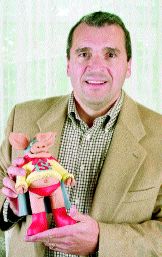 "Service is the rent we pay for the loyalty of our customers. The rent is going up!" cautioned Quebec broker Michel Drouin.
Brokers have no control over price, Drouin said, so he advised investing more time and money in what brokers truly control:
* Employees' educational and professional skills
* Marketing
* Technology upgrades.
"What do my existing and future customers want?" he asked.
* To talk to highly skilled employees
* To receive the specific information they need about insurance products
* To have a value-added relationship with a broker
* To feel safe.
How do we respond to those needs? "Create your own vision. Walk the talk. Implement. Measure." As a final thought, Drouin offered his definition of service. "Service is the rent we pay for the loyalty of our customers. The rent is going up!"
The Career Map
The last presentation of the session was made by Rick Bauman, who outlined the elements of The Account Executive Career Map(TM) his firm uses with its clients. The map was developed on the basis of four premises, he said:
* Account executives are the lifeblood of brokerage growth.
* Most account executives eventually plateau.
* Most account executives do not have a "vision" for their careers.
* "The ears only hear and the eyes only see what the brain is seeking."
The Account Executive Career Map has three purposes, Bauman explained:
* To provide a graphic representation of an account executive's career, expressed in terms of results
* To help account executives succeed through goal setting
* To help brokerage owners get results by setting clear expectations.
The map guides the account executive's progress from handling entry level accounts up through C, B, and A level accounts (ranked in terms of revenue) and establishes time horizons, income amounts, and service support for each succeeding level. The map also allows sales management to set and track critical indicator and critical activity expectations. The map is not only an invaluable guide for present account executives, Bauman pointed out, but also a great recruiting tool for prospective AEs.
High fives
Participants at the first Dare to Soar meeting north of the border were enthusiastic about what they learned, eager to try out new strategies in their own brokerages, and already looking ahead to next year's meeting. For his part, Rick Bauman is excited about the opportunity to share his profit-building strategies with top brokers, and it shows.*
For more information:
Bauman Consulting Inc.
Suite 402, 390 Brant St.
Burlington, Ontario, Canada L7R 4J4
Phone: (888) 699-7333
Web site: www.baumanconsulting.com