New Program Administrators Association could emerge
By Dennis Pillsbury
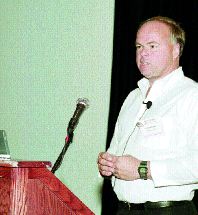

Glenn Clark opens Target Markets Meeting
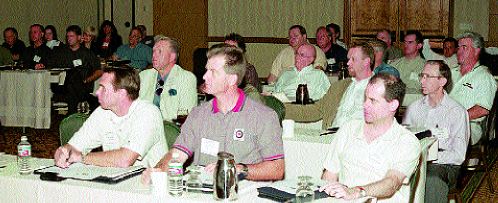
The brainchild of Glenn Clark, CPCU, owner and president of Rockwood Programs, the summit offered presentations by technology firms on new technological advances that can help program specialists succeed in today's marketplace, and by insurance companies describing the markets they offered. Workshops on program valuations, dealing with reinsurers and MGAs, establishing alternative risk transfer programs and other matters of interest to program administrators were offered on the afternoon of the first full day of the meeting. The summit was co-sponsored by Tillinghast-Towers Perrin.
Glenn explains that his concept is "to establish an association dedicated to supporting the unique needs of program specialists. We're trying to create something new for this segment of the insurance arena." He continues that the idea is to have a meeting where "everyone is actively involved in program business. We turned away 16 companies that wanted to come because they were not active supporters of the program business. Only program administrators and co-sponsors are in attendance here," Glenn adds.
Timing is everything
The current state of the insurance marketplace certainly helped to make the summit especially cogent. The dislocations produced by the hard market have had both positive and negative effects on program administrators.
On the positive side, they are seeing increasing numbers of submissions coming to their doors as retail agents find their own markets demanding more than they can give in some instances. On the flip side, some program administrators are finding that their own markets are leaving due to capacity shortages or a change in marketing philosophy. The summit provided the networking necessary to develop new relationships for current programs, as well as opening up opportunities for cross-selling and clustering where products and/or geography afforded such initiatives.
Feedback results
The results of two feedback forms completed by most of the participants in the summit certainly indicate that there is a general consensus that a new association would be valuable. One form asked for a 10-point evaluation of the conference and the other solicited ideas regarding the establishment of an association.
Networking was a clear winner, receiving a rank of 9.7 out of 10, although nearly all aspects of the conference also scored very well. In fact, the lowest score of 7.8 for the technology session was still very respectable. Networking also was cited in response to an open-ended question about the most positive thing about the summit. Forty-eight of the 98 respondents said networking, followed by 27 citing meeting carriers interested in program business.
The formation of a new association also was received favorably, with 96 of the 103 respondents saying they "would like to be involved in starting a new association dedicated to the issues faced by agencies specializing in program business." A slight majority (58.3%) said they preferred an association that was 100% owned and funded by members, while 34.5% favored an entity owned and funded by a combination of members and organizational partners. The balance (8.2%) favored an entity owned by an outside firm. Nearly three-fourths (54 of the 73 responding to the question on dues) said they felt that $1,000 a year was an equitable amount to pay for membership, while 17 selected $500, and only two felt that less than $500 was appropriate.
Conclusion
This certainly appears to be an idea whose time has come. The next phase, however, is critical. Interest has to be turned into reality. That means not only do potential members have to contribute money to the new association but, even more crucial in these very busy times, many have to be convinced to contribute that very scarce commodity--time. *

For more information:
Target Markets Program Administrators Association
222 Philadelphia Pike, Suite 17
Wilmington DE 19809
Phone: (302) 765-6000
Fax: (302) 765-6037
Web site: www.targetmkts.com