SOUND INTERNET SOLUTIONS
ENHANCING WEB SITE USABILITY
Two books offer insight, practical advice
By John Ashenhurst
If you make your Web site visitor work too hard at something that should be relatively transparent and effortless, your site won't succeed.
 Agency Web sites can be an important extension of traditional marketing, sales, and service efforts. But poorly done sites can diminish agency credibility and drive away customers. Two recommended books provide commonsense, general advice about how to make your site more usable--and thus more useful to your prospects and customers.
One is Homepage Usability, 50 Websites Deconstructed, by Jakob Nielsen and Marie Tahir. Jakob Nielsen and Donald Norman have collaborated for years, through their Nielsen Norman Group, to bring usability to the design of software and physical objects. One doesn't have to look far to realize they still have plenty to do. (Norman is the author of the best-seller The Design of Everyday Things Tahir is an alumna of the Nielsen Norman Group.)
I've reported on and employed Nielsen's insights relative to Web site design in past articles and have recommended his book, Designing Web Usability, which is now available in 14 different languages. His new book, Homepage Usability, focuses strictly on homepages, rather than the larger subject of his earlier book.
Every site must have a homepage. Generally it's the first thing a visitor sees. If the homepage doesn't immediately appear to be relevant, the visitor will click the Back button, perhaps never to return. So the homepage has a special role to play and it's critical to the success of the site. There are a finite number of principles of good homepage design, and Nielsen has laid out and illustrated them in his handsome new book.
Nielsen/Tahir devote the first 50 pages to an overview of the principles of homepage design. The discussion is so clear, well organized, and convincing (well, of course one can take exception here and there) that you want to immediately check your own homepage, something Nielsen anticipates and helps you do. The results of a self-evaluation can be discouraging but certainly provide you specific ideas for improvement.
The balance of the book examines 50 homepages, mostly by well-known organizations, such as Amazon, Citigroup, and ESPN. Each homepage is reproduced in color, and the accompanying text offers in-context concreteness that the earlier general principles section lacks. The book lends itself to browsing as well as reading through. I highly recommend it.
Your homepage is the most important one on your Web site. It's where visitors form quick impressions and it's the entry point to marketing, sales, and service content. The tips below have been extracted from an extensive list in Homepage Usability: 50 Websites Deconstructed.
1) Who are you? Visitors need to know who you are, first thing. Your agency name and logo should be quickly visible, perhaps best placed in the upper left corner. They should be large enough to digest but not take too much screen real estate.
2) What do you do? Visitors also need to know what you do and perhaps why what you do is special. You need a tag line that succinctly summarizes what you are all about. Then you may need to provide other summary information that further positions your organization.
3) What's important? Take time to figure out what's most important in your site from your visitor's point of view and then make sure you provide clear and direct access to those other pages from your homepage. Make your site convenient to navigate.
4) Homepage uniqueness: Your whole site should have functional and design consistency, but your homepage should stand out from other pages. Visitors should know immediately that they're on the homepage and not a subsidiary page.
5) Communication consistency: Your homepage and your site in general should be consistent in look and content with all other communication efforts--whether brochures, business cards, letterhead, invoices, signage and so on.
6) Privacy: Web visitors are often concerned about identifying themselves in any way because they suspect their personal information will be used to irritate them via spam, calls, junk mail, and the like. If you take information, make certain you have a privacy policy, explain it, and then live with it.
7) Out-facing language: Language in text and headings should be oriented toward how customers see you and what they're likely to be interested in rather than how the customers fit into your business plan and organizational structure.
8) Primary navigation: Make it easy for visitors to understand how to navigate your site, generally through a menu in a left-hand column. Make the whole menu always visible. If visitors don't see something immediately, they may assume it isn't there. Navigation at the top of the page, especially if it's above some graphics, tends to be ignored.
9) Search: Every site, unless it's very small, should have a site search capability. Put the search box in an obvious, easy to spot place, perhaps at the top of your left-hand menu column. Make it wide enough to be usable and put a "search" or "go" button next to it. Don't offer general Web searches. It isn't necessary and you'll confuse the visitor.
10) Animation: It's almost always a mistake on the home page (or any other page) unless it illustrates a concept--but not if it's just intended to attract attention. Site visitors deliberately tune out flashing fields and may be annoyed enough to go someplace else.
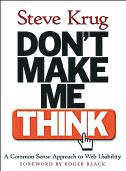
Another book I'd recommend is Steve Krug's Don't Make Me Think, A Common Sense Approach to Web Usability. It has become something of a classic on Web site design.
The author's touchstone--that Web sites should be effortless to understand and navigate--is good advice and an antidote to tendencies toward the fancy and the vain in Web site design.
Krug's book is written in an accessible and down-to-earth style. He explains, at some length, his First Law of Usability--namely "Don't make me think"--and goes on to describe how people really use the Web--rather than how we imagine they do--and the implications for Web site design. Krug explains why Web pages need to be designed for scanning, not reading; why visitors like mindless choices; how to write for the Web; and outlines principles of successful site navigation. His section on how to do simple usability testing on your own site is worth the price of admission.
Though not as elegant as Nielsen's book, Don't Make Me Think may be more immediately practical. It worries more about your Web site than what 50 major multi-national corporations are doing with theirs.
If you make your Web site visitor work too hard at something that should be relatively transparent and effortless, your site won't succeed. If you try to impose your ideas about how your site should be used on your site visitors, they're not going to be impressed. As Krug says, "The first step in recovery is admitting that your homepage is beyond your control." What follows are 10 ideas cribbed from Krug's book.
1) Usability just means making sure that something works well, and that a person of average (or even below average) ability and experience can use the thing.
2) Don't make me think: This is the first law of Web site usability--and is more important than "Nothing important should ever be more than two clicks away," or "Speak the user's language," or "Be consistent." It's the ultimate tiebreaker when trying to decide whether something works or doesn't work in a Web site design.
3) Self-evident: A Web page should be self-evident, obvious, and self-explanatory. The visitor should be able to "get it"--that is understand what the site is and how to use it--without having to think about or puzzle over it.
4) A simple test: How can you tell whether your Web page and site is self-evident enough, that it doesn't require visitors to try to figure it out? Imagine your neighbor, who doesn't know much about the Web or insurance visiting your home page. Would he or she know--effortlessly--what the site has to offer, how it might be relevant, and how to retrieve it?
5) Things that make us think: A great number of things about a Web page can make us stop and think--unnecessarily. Names that are too cute; clever marketing jargon, internal to the business; or unfamiliar technical terms are some causes of unnecessary thinking.
6) Why worry about making visitors think? Having to think about how to do something rather than just doing it absorbs mental energy. It creates friction and barriers. It can lead people to be frustrated or even embarrassed at their lack of knowledge and skills. The more your site makes them think about how to use it and
what it means, the less motivation and energy they'll have to understand and pursue your message and value.
7) You don't need another checklist: It's much more worthwhile to become sensitive to eliminating question marks in your site visitor's mind. If you do that you'll become adept at recognizing and then eliminating them on
your site.
8) Self-explanatory: It's not always possible to make your site and Web pages entirely self-evident. Sometimes what you need to convey is complex or unfamiliar. If so, make that section or aspect self-explanatory. On a self-explanatory page, it takes a little thought, but only a little to "get it."
9) How people really use the Web: We'd like to think that they're systematic and thorough, but that's not even remotely true. Site visitors don't pore over each page. They glance at each new page, they scan some of the text, and then usually click on the first thing that looks relevant.
10) "Satisficing" and muddling: Web site visitors don't work to make optimal choices. Instead of choosing the best option, they choose the first reasonable one--they satisfice. And site visitors don't make the mental effort to try to understand how your site works; they just muddle along, making do. Your site should provide good outcomes for satisficers and muddlers.
If you want to improve your Web site, it would be worth your while to consult one or both of these books and then apply what you've learned to what you've already done--and then begin to work on your Web site makeover. *
The author
John Ashenhurst is editor of Sounding Line, a monthly newsletter covering insurance and the Internet. His company, Sound Internet Strategy, provides consulting, Web site evaluation, and seminar services to independent agents and their trading partners. He can be reached at johnashenhurst@soundingline.com
or (360) 376-1090.