MARKETING AGENCY OF THE MONTH
In the past 10 years, Gilbert's Insurance has grown by more than 300%
By Dennis Pillsbury
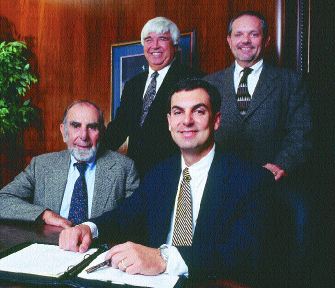
Gilbert's Insurance Agency principals--standing (from left): Matthew Lazaroff, vice president, and Kenneth W. Johnston, CPCU, vice president; and sitting (from left): Thomas G. Kachulis, CPCU, and Lew Kachulis, CPCU, president.
Change is a constant in the agency business. And no matter how much we may wish that were not so, it is as the English Romantic poet Percy Bysshe Shelley reminds us:
"Man's yesterday may ne'er be like his morrow; Nought may endure but Mutability."
It is our ability to manage that mutability--that continual change--that can be the difference between success and failure. Successful agencies are those that not only deal with change but also invite it and use it to grow. Quite often, new blood with new ideas serves as a catalyst for change that helps to transform the agency into an even more successful venture, provided that the other constants of client service and good relationships with the insurance company partner are maintained as the agency transforms itself.
Gilbert's Insurance Agency, Sharon, Pennsylvania, stands as a testament to focused transformation. Throughout its nearly 150-year history, the agency has changed itself to meet the needs of the residents and businesses in the Shenango Valley. The agency was founded in 1854 by M.L. Murdock and assumed its current name in 1923 when John Gilbert merged his agency with it. In 1934, Gilbert's moved to 21 Vine Avenue and has been there ever since. In 1986 Gilbert's became a member of the Keystone Insurance Group.
Today, there are four agency principals--Tom Kachulis, Lew Kachulis, Matt Lazaroff and Kenneth Johnston. It is one of the largest agencies in northwestern Pennsylvania with 20 employees and total premium volume (including life and health) of over $20 million. Lew, who joined the agency in 1990, is president.
The past 10 years have been among the most dramatic for the agency as it grew by more than 300% and went from a volume-driven focus to a focus on profitability. "As we saw the industry head into the current hard market, we realized that our insurance companies would no longer be looking just for volume," Lew points out, "but for quality clients that had strong loss control and loss mitigation programs in place and offered a real opportunity for profit."
Prior to joining the agency, Lew had been with Westfield Insurance Companies and then with CNA. At Westfield, he worked in commercial lines underwriting and internal audit. Lew says: "Working in internal audit provided great experience. I worked with every department in the insurance company."
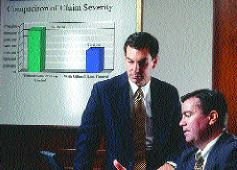 Lew discusses a safety program with James T. Culligan, account executive/accident prevention consultant.
In 1988, Lew decided to try big city life and looked for positions in either New York or Chicago. He was hired by CNA in Chicago as a premium audit supervisor. After two years, CNA offered Lew an opportunity to transfer to the Indianapolis office. At the same time, his Dad, Tom, one of the owners of Gilbert's, talked to Lew about working with the agency.
"I wasn't sure that I was suited for the agency business, so I agreed to work for one year and find out," Lew remembers. "I would be evaluated after that year. It turned out to be the right decision. I've never looked back. This is where I was meant to be." (By the way, the Indianapolis office of CNA was shut down a few years ago. Yet another reason why Lew made the right decision.)
Lew spent the beginning of his agency career in an extended soft market that saw companies writing nearly everything they could get their hands on. "About two or three years ago, we saw the market changing and decided we needed to change." And that's when Lew's company background rose to the fore.
"We had a number of problem accounts that we placed with EBI because they specialized in turning around workers comp problems," Lew explains. "The EBI model really worked. Their representatives would go into a company and work with management to implement safety programs and other loss control efforts. When EBI was purchased by Royal & Sun Alliance in 1999, we were concerned that the EBI focus might change, so we decided to replicate it inside the agency. We went to our clients and asked them if they would be interested and their answer was 'yes.' So we set out to recreate the model."
Lew continues by pointing out that his dad wasn't so sure that it would work, but "he let me try it out. He's a great person who's always receptive to new ideas. His attitude was that he'd rather see me make mistakes while he was still at the agency so he could help pick up the pieces." (Lew is just completing a 10-year buyout of his dad's ownership in the agency.)
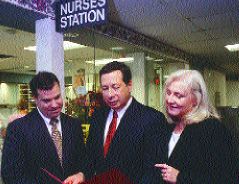 Jim Culligan (left) and Marie Swanson (right), claims manager, go over the loss control program for Jameson Health System with Neil A. Chessin (center), vice president of human resources at Jameson.
The first step was to hire the people who could manage claims and control losses.
The agency hired Marie Swanson, an EBI claims representative who had worked with more than 40 companies to mitigate their workers comp claims. Her goal was to establish immediate involvement with injured employees, their employers and medical providers in order to resolve claims quickly and get people back to work.
In addition, Jim Culligan, an accident prevention consultant with EBI, was hired to provide loss control services to Gilbert's clients. Jim also had been a risk manager with Monongahela Valley Hospital. While at EBI, Jim had been able to reduce the loss ratio of a $3 million book of business from 80% to less than 40% in one year. He accomplished this by working directly with the management of the companies to formalize their loss prevention programs.
With these new additions, Gilbert's approached clients with an offer to help them reduce their workers compensation losses. "We were working to create a win-win-win-win situation," Lew says. "The employees win because they work in a safer environment; the employers win because their workers compensation costs are lowered; our insurers win because they are writing more profitable business; and Gilbert's wins because we have established a long-term relationship with our clients where we are viewed as indispensable consultants to their business rather than simply insurance salespeople."
Jim Schneider, producer for Gilbert's and former field marketing representative with The Cincinnati Insurance Company, states: "The ability to bring this type of value to our client relationship adds a new dimension to the sales process because the results speak for themselves." The results, thus far, have been excellent. A study done for Gilbert's by an intern at Slippery Rock University, Slippery Rock, Pennsylvania, found that, in its first year, the program reduced the frequency of claims by 51% and severity by 49%.
The program
"We start by touring a client's facility to identify areas where there might be problems," Lew says. "We also evaluate the last three to five years of losses to determine where the cost drivers are and then create a business plan for them that focuses on driving down the number and severity of claims. Our emphasis is on behavior. We try to heighten the level of awareness and change the corporate culture in terms of safety and loss control. We have to have the total commitment of management for this to work. We explain to them that this is an investment and are upfront with our goals, which are to reduce workers comp costs by 75% over a three-year period of time.
 Lew responds to a client's questions about their workers comp program.
"There are two common programs within the business plan--the accident repeater program and the supervisor accountability program," Lew continues. "The accident repeater program begins with interviewing all employees with more than one claim in the past five years. The interviews focus on preventing future accidents. This serves to heighten the level of awareness, which oftentimes is enough to reduce accidents. The fact that the employee gets to provide input in a non-threatening interview also serves to enhance morale. It's also been viewed favorably by organized labor. At the same time, if the employee has been involved in questionable accidents, he or she is now on notice that we are watching. We've found that anywhere from 25% to 75% of the claims come from repeaters. Normally, the repeaters represent less than 10% of the workforce."
Jim Culligan states: "The supervisor accountability program is the critical component to reducing an organization's accident frequency. Supervisors are held accountable for safety. Gilbert's Prevention Consultants conduct routine department safety audits that provide feedback to supervisors. The feedback allows supervisors to improve their departments' safety record. Upper management is made aware of the results of a supervisor's department safety audit. I always tell people I spent four years in the Air Force, and never saw a jet go up dirty when the pilot's name was written on the side!"
The ultimate goal is to prevent accidents, but when claims do occur, Gilbert's is there to help mitigate the impact. Marie Swanson attends all workers comp hearings to keep abreast of how the claims are progressing. She also works with all affected parties to make sure the claim is handled quickly and fairly. If she determines that a claim is questionable, she can recommend an investigation. She also works with employees to establish light-duty and return-to-work programs.
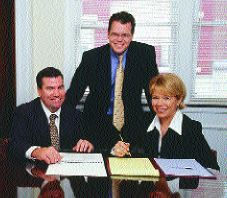 Account executives with Gilbert's Insurance include (from left): Jim Culligan, James Schneider (standing), and Robin Miller, CPCU.
Lew reports that the program has been greeted favorably by insurance companies. "Some companies will quote two prices for coverage--one with our loss control and one without."
He continues: "One of the key factors is that this is fee based. We will discount the fee if we have the property/casualty and group health business. We found that if the employer is paying for the loss control business plan, they're more apt to implement recommendations. If the service is provided for free, the results are not as good."
The success of the program has been dramatic. In addition to offering it to many of its own clients, Gilbert's has been sought out by other agents and insurance companies and also by self-insured entities. "We're a licensed TPA in the state of Pennsylvania."
Lew adds: "We're almost a mini-company now. We have an underwriter on staff who regularly hand delivers proposals to insurance companies and discusses the account with their underwriter. That's worked really well in building and maintaining a relationship of trust with the company. We also have a registered nurse on staff who helps resolve third-party payor disputes for health care, assists employers in correcting erroneous health claims and provides education about health benefits to employees."
Long-term commitment
The objective of the workers comp program clearly is to establish a long-term relationship with clients. At the same time, Gilbert's works hard to have long-term employees.
"Twenty percent of our profit is shared with employees and most employees have additional incentives," Lew points out. "For example, our CSRs receive a bonus that depends on the amount of revenue the CSR is servicing. We wanted the producer and CSR to have common goals and create a sense of teamwork and camaraderie. Before, when a producer brought in a ton of business, all it meant to the CSR was additional work. We recently had a meeting to discuss individual goals and one producer said his goal was to add $200,000 in revenue and the CSR was delighted."
The agency is a Sub S corporation. Another incentive involves stock. Producers are gifted $100,000 of stock when their annual renewable revenues exceed $250,000. "We have two producers who will qualify for that this year and that's great," Lew says. These soon-to-be new owners are both in their 30s. "I just turned 40 this year," Lew continues. "It's a pretty young, dynamic group. There's a lot of positive energy in this office," Lew concludes. "We're doing great and things will get even better. We are always acting in our clients' best interest by reducing their losses, which results in reducing their premiums." *