Great Northwest program lets agents issue policies on the spot
By Dennis Pillsbury
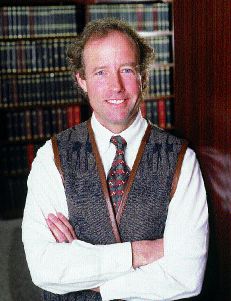
Stephen W. Doucette, president, Great Northwest.
I'm very pleased with our relationship with Great Northwest," says Bart Kinney of Kinney Insurance, Inc., Albuquerque, New Mexico. "We've always been an agency that prefers the one-and-done approach. If there are mistakes, we know that they're ours and have a much easier time tracking them down."
Bart continues that Great Northwest "offers an innovative approach that lets us deliver policies quickly and provide a high level of service to our clients. The reality is that New Mexico is not the world's largest market and we have had a problem with companies coming and going. Great Northwest provides a stable market for personal lines." (Kinney Insurance writes about
$30 million in premium, with 15% of that coming from personal lines. Great Northwest handles approximately 20% of their personal lines volume.)
Bart admits that the Great Northwest system "certainly involves a trade-off. There's a learning curve involved. We've probably had to spend more money and training time to get up to speed. Debbie (Roche, who serves as the underwriting and claims manager for the Great Northwest business) has had to go to at least two schools. But the end result makes it worth the effort."
The Great Northwest approach
Great Northwest is the brainchild of Stephen W. Doucette, president, who was convinced that independent agency companies could operate just as efficiently as direct writing companies if they better utilized the unique skills of these local entrepreneurs. "Companies have experimented with alternative marketing methods," Steve says, "and they invariably don't work out. That's because the customer looks to his or her agent as their source for insurance advice and coverage. And most of the alternative methods tried to eliminate the most important person in the mix--the independent agent. The agent is the person who has the relationship with the client and, in many instances, is the only insurance person the client trusts. It also doesn't make sense to try and engineer that agent out of the process, because the agent is not the part of the system that is inefficient."
Steve continues that he decided to set up a company that took advantage of this position of trust by having the agent be the only contact with the client for virtually all aspects of the insurance transaction, while the company would be responsible for the "back office stuff." He set up Great Northwest to bring his vision to reality. Great Northwest basically is a management company with the insurance risk going to its three principal partners--AXA, GE and Hannover (Clarendon). The fronting fee is five points.
Under this unique organizational structure, the central element is the Great Northwest Quality Control Center, which is used only as a facilitator, trainer and quality control engineer. It does not do any customer functions. This allows the company to be very lean--there are only nine employees: five accountants, one community manager, two techies and a president.
The independent agency becomes a Micro-Insurance Company® (MIC) responsible for underwriting, policy issuance and claims payment for small claims (under $10,000). An underwriting and claims manager (UCM), who is trained by Great Northwest, is appointed by the MIC and manages all underwriting and claims administration. The MIC has the authority to handle all claims under $10,000 without outside adjuster involvement; Great Northwest directly, or through contracted claims administrators, supervises claims over $10,000, and directly manages claims over $50,000.
Under this structure, Steve maintains, "we have eliminated the duplication of the traditional insurance structure. Instead of a three-headed hydra, we essentially have chopped two heads off--the home office and the branch office--and have retained the agency."
Technology is the key
Great Northwest's proprietary technology is the foundational support for the system. The software, which has been operational for eight years in more than 100 locations, allows the MIC to transact all customer functions interactively. Customer information, rating, electronic underwriting, policy issuance, renewals, claims administration and reserving, customer accounting, document production, statutory and management reporting, and other required functions are all performed by the automated system. In addition, Great Northwest has full Internet capabilities both for MIC and customer access.
The technology also provides for quality control management through expert systems that basically allow Great Northwest to monitor the MICs electronically. "The systems look for statistical reliability and have been tested over time," Steve says. He points to the fact that the company boasted a 92 combined ratio in 2001 as proof of the system's ability to monitor the quality of the business.
He adds that peer pressure also helps to maintain quality. "Profit sharing is a big part of the business," Steve points out. MICs receive a commission of 10% on new and renewal business but also share in profits in a state when the incurred loss ratio is below 67.5%. "The performance information for each MIC is shared with each member in a state team." Each UCM and agency principal is part of a state team. UCM teams in a state are responsible for second-tier underwriting guidelines, general screening of potential new MICs, communicating state issues and concerns and, as mentioned above, quality control. Regular UCM meetings are held in each state. Each state has a UCM team leader who is paid for these services by Great Northwest. In addition, there is an annual national UCM meeting. Great Northwest currently operates through 100 locations in 11 states and will be adding Illinois and Nebraska in the near future.
Approximately 75% of the business written is private passenger auto, with most of the balance being homeowners and a very small number of BOPs. The business is basic business, using standard ISO forms. Maximum limits on auto insurance are $100,000/$300,000. "We don't do any upscale business," Steve notes. "We're looking for standard business that can be easily analyzed by our electronic underwriting system."
For an agency to be considered to become a new MIC, it would need to roll over approximately $200,000 to $250,000 in personal lines business.
A way to stay on the cutting edge
"We added Great Northwest as one of our personal lines companies about four years ago," says Kathy Dahedl, personal lines manager for The Maguire Agency, Roseville, Minnesota. Kathy, who serves as UCM for the Great Northwest business, says "our agency tries to stay on the cutting edge and we're always looking for new, innovative ways to serve our clientele. We didn't know how this would work but decided it was certainly worth a second look."
She continues that the program "has allowed us to provide better service to some of our clients and provides us with better control. We can issue an auto or homeowners policy on the spot for people who make an appointment and come into the agency for an insurance review or other business.
"The computer system is extremely easy to use and truly is one-and-done."
The Maguire Agency has about $200,000 in personal lines premium with Great Northwest. The agency's total personal lines book is approximately $7 million.
"We're still taking it slow but expect to be increasing our volume significantly with Great Northwest this year," Kathy says. "The program has proven to work and we have implemented in our daily procedures. The business has been profitable and retention seems to be better. Most important of all," she concludes, "is control. It helps us write a lot of business quickly. Our producers love it."
Kathy also serves as the team leader for Minnesota, which she says has been "a great benefit to our agency being involved with all the agents in the Great Northwest group. We have been able to share ideas, build relationships with other agents, and help each other deal with many of the daily issues we all face. The benefits of the interactions and sharing of information helps with issues with our other carriers, not just Great Northwest. It has been very rewarding to meet and build those relationships. It is a great group of professional and knowledgeable agents." *
For more information:
Web site: www.greatnorthwest.com