RISK PROBLEMS/SOLUTIONS
PROPERTY EXTRAS--POTENTIAL E&O?
By LeRoy H. Utschig, CPCU, ARM
 Rarely does a commercial client provide an insurance agent with all of the information needed to properly design an insurance program. Only by systematically asking questions is an agent able to learn all that needs to be known. In addition, the process of learning about the client is made even more difficult because there is so much information to cover and not much time in which to do it.
You can, however, help limit your discussion with a client to less than five minutes. To properly document your file, you need only to mark off "needs" or "refused" on a coverage checklist. Then have the client sign and date the checklist. Marking off a coverage checklist and having a client sign it can be an effective way to preclude an errors and omissions claim
All of the loss exposures presented here are not automatically covered by ISO's normal property form. Usually the coverages can be added to a commercial property contract through the use of an endorsement.
In an actual case, a coverage checklist proved to be very useful. The client had on display a model of an airport terminal, depicting in detail the architect's rendering of a proposed expansion project. The model was displayed away from the architect's premises. When the model sustained $7,000 in damage, the client wanted full reimbursement, but there was no insurance on it. The client began to talk lawsuit.
However, the agent talked facts--he had filed a copy of the client's coverage checklist. In fact, the insured's folder contained checklists for each of the five preceding years. All of the checklists--which had been signed by the client--showed that he had stated that there were no off-premises property exposures. The agent gave the client copies of the checklists and told him to give them to his attorney. After looking them over, the client's attorney understood that he had no basis for an E&O claim.
For the following property losses, the examples provided are fictitious.
Legal liability
For two weeks, the temperature hovered around the zero degree mark. Heating systems were not large enough to cope with such a severe temperature. Manufacturing, Ltd., occupied one of the buildings in an industrial park owned by Industrial Park, Inc. On a Friday, while the outside temperature was zero degrees, Manufacturing's heating system broke down. By Sunday, the outside temperature was in the 40s.
On Monday, when Manufacturing's employees opened the building, they were greeted by water on the floor. Then they heard water running. Within minutes they discovered that the automatic sprinkler system had ruptured. In many places, the piping for the fire protection system had ruptured lengthwise. This type of break allowed water to spray out for quite a distance. Because the breaks were small, the water pressure remained high enough so that water could spray out of many different breaks throughout the property.
Industrial Park had both the heating and automatic sprinkler systems repaired and then set about calculating the damage. The water had damaged many of the machines and the hundreds of computers that controlled them. There also was damage to raw stock and product that was ready to be shipped. Manufacturing submitted a claim for over $2 million to its insurer, Shifty Mutual, LLC.
In the middle of settling the claim, the owners of Manufacturing (ML) noticed the word "subrogation" on some of the forms that were to be signed and asked what subrogation meant. Shifty Mutual responded that after paying ML, the insurance company would try to collect over
$2 million from Industrial Park. The rationale for this process was that Shifty Mutual wanted to recover its loss payment from the firm(s) that caused the loss. It was Shifty Mutual's position that the loss was caused by negligence on the part of Industrial Park.
Manufacturing did not want to sign the subrogation forms. It was concerned that signing them would jeopardize its relationship with Industrial Park.
Shifty Mutual then explained that either ML would sign the subrogation forms or there would be no coverage for the $2 million-plus loss. Manufacturing signed the subrogation forms.
Upon receiving the subrogation request from Shifty Mutual, Industrial Park (IPI) submitted the subrogation material to its insurer, Tough Insurance, Inc. A short while later, Tough Insurance informed IPI that there was no coverage. Tough Insurance took the position that the care, custody and control provisions in Industrial Park's general liability policy precluded providing coverage.
Whether or not you agree or disagree with the application of the care, custody and control exclusion in this example is not the issue. The scenario is used to illustrate a possible exposure and then give a solution to a type of loss exposure. The Insurance Services Office promulgates a property form to cover the loss exposure--a property form called Legal Liability.
A bit of history for any "old timer" reading this. Many years ago we used to write a form called "sprinkler leakage legal liability." This form was used to cover the type of loss scenario cited above. To the best of my knowledge, the old sprinkler leakage legal liability (SLLL) is no longer available. The current legal liability form replaces the old SLLL and gives coverage for many more perils.
A coverage checklist should contain the words "legal liability" in the property section. In fact, you might put this immediately above or below the words "subrogation waiver." Subrogation waiver will be addressed in a future issue.
Landscaping
Office, Inc., owned its own building. The area in front of it was very attractive. There were several mounds of dirt with flowers, shrubs and stone on them. There were several trees that were about seven inches in diameter, and a stone/split rail fence provided the boundary.
Not long after the landscaping was finished, a loaded gravel truck owned by Older Truck, Ltd., careened off of the road in front of the Office building, plowing right through the middle of the landscaping. It had lost its brakes and its driver had steered off of the road so that the truck would stop and not hit anybody.
Repairing the damaged landscaping would cost about $50,000. Office presented a claim for this amount to Older Truck, but Older Truck replied that it had no insurance and was filing for bankruptcy. It appeared that Office (OI) would not be able to collect anything from Older Truck, so it presented a claim to its insurance agent. The insurer's answer was that there was no coverage for the damage to the landscaping.
However, a new agent trying to write OI's insurance program said that that an endorsement could have insured the landscaping!
Fences
Warehouse, LLC, had many large warehouses, one of which was located near an expressway off-ramp. It had a fence that, on two sides, bordered the off-ramp. The highway was higher than the top of that warehouse building at the point at which the off-ramp started.
On the morning of the accident, the expressway was patched with wet spots and, in other places, with drifted snow. Other spots were covered with black ice (this is thin ice you can't see because it blends with the roadway). Due to the changing conditions of the roadway, most traffic was doing about 40 mph.
Speedy, the driver of a four-wheel-drive SUV (sport utility vehicle), thought that he could drive better and faster than anyone else. He was driving about 70 mph when he hit the beginning of the off-ramp. At that point, black ice covered the entire ramp and its berm (shoulder). The combination of the slope and the black ice caused Speedy to lose control of his SUV. It became airborne for about 300 feet before it hit the warehouse fence, pulling down about a thousand feet of eight-foot-high cyclone fencing.
Warehouse presented Speedy with a claim for the damaged fencing. Speedy had "purchased" the SUV via a long-term leasing program that included insurance; however, he had not been making his lease payments. A day before the accident, the auto dealership had started repossession proceedings. As part of those proceedings, the insurance on the SUV was terminated. Speedy had no insurance to cover the damaged fencing.
Because Speedy was not going to pay for the damaged fencing, Warehouse presented its own insurance company with the claim. The insurer denied it. Adding an endorsement to Warehouse's property insurance program could have insured the damaged fencing.
Flood
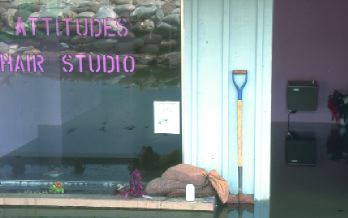
Heavy rains had been pouring down for most of the past two weeks. Refreshing, Inc., a restaurant, was located more than two miles from the river that ran though the central Iowa town. The parking lot was shedding water just as it had for the past 20 years. Suddenly, the owners of the restaurant noticed that water was not running off and was beginning to accumulate. It continued to do so for the next week until it was eight feet high inside the restaurant.
While the river could not be seen from Refreshing's location, old, dried-up waterways led from its location to the river. The unusually large amount of rainfall caused the rising water to follow the old waterways and eventually flood the restaurant.
Because Refreshing did not have flood insurance, it had to pay for its own repairs. When Refreshing presented an errors and omissions (E&O) claim against its agent, the agent could not demonstrate that he had offered flood insurance. Marking "refused" on a coverage checklist signed by Refreshing would have aided in defending the E&O claim.
Many businesses are located in areas that appear to be flood proof. However, they are located in flood plains. A flood plain is an area of ground that is located between the normal waterway and the highest or widest water that has ever occurred at that location. It is virtually impossible to pick out some of these flood plains with the naked eye.
Flood relief maps show flood plains, and the National Flood Program is a good source. Secure the flood relief maps for the area where you operate. It does not take much time to look at a map to determine if your clients are in a flood plain and inform them of this fact.
A footnote to flood insurance: Many insureds will refuse to purchase flood insurance--even people who previously have been flooded out. However, using the checklist will provide you with documented evidence of the client's refusal to buy coverage.
Summary
* Legal liability can be purchased to protect against a loss generated by a landlord's negligently damaging tenant's property.
* Landscaping can be insured.
* Outdoor fencing can be covered.
* Flood relief maps can be used to identify clients on flood plains that are not obvious. *
The author
LeRoy H. Utschig, CPCU, ARM, is a Wisconsin-based insurance educator, consultant and expert witness.