TECHNOLOGY
With the AUGIE survey results as an indicator, user group presidents comment on the business implications behind the survey results
By Bill Jenkins
The importance technology plays within an agency's overall business plan is sometimes indicated by how they treat the expense of automation within the budgeting process.
Source: ACORD-User Groups Information Exchange. Used with permission.
Effective budgeting for technology goes beyond the "hard costs" associated with new hardware, software, and timely upgrades. An all-too-often-overlooked aspect of enhanced agency productivity is education and training.
When it's time for an upgrade or enhancement to your agency management system--either software or hardware--do you have to rob Peter to pay Paul? Or have you made technology a line item on your overall agency budget? No matter how you respond to these questions, you're in good company.
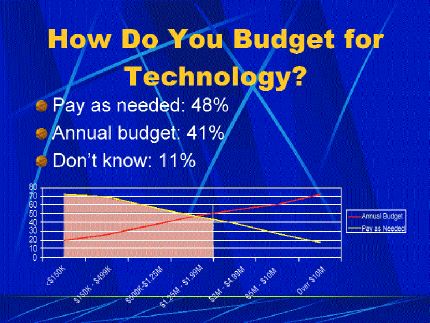
The chart on page 174 illustrates the responses to one of the questions included in a recently completed survey conducted by the ACORD--User Groups Information Exchange (AUGIE). More individuals responded to this survey than any other in the history of our industry, with some 9,000 CSRs, producers and agency owners participating.
Why such an overwhelming response? Primarily, it's due to agency management system user group participation in the creation and promotion of the AUGIE survey. The survey identified several automation challenges which agents face--among them, budgeting for technology. For insights into the details of the accompanying chart, we contacted agents who devote a great deal of personal time and attention to technology issues through their own involvement as volunteer user group leaders. Those interviewed for this article include: Peter Anderson with Anderson Insurance Services in Boston, Massachusetts--president of the Applied Systems Client Network; Mike Hofmeister of Bruce F. Grau & Associates and Insurance Incorporated in Timonium/Hunt Valley, Maryland--president of the National Association of S.I.S. Partner Agents; Phil Moyer with the Weis Agency in Salamanca, New York--president of the DORIS User Group; Pam Parry of GRP Risk Solutions in Tucson, Arizona--president of the AMS Users Group; and Robert Pachner of Kaye Group in New York City--president of VIP Users Group (representing users of VRC Systems).
As one looks at the chart that illustrates agents' response to the question "How do you budget for technology?" one fact is clear: The smaller agencies that responded are more likely to pay as they go, while virtually all larger agencies that responded budget annually. At first glance, the reason seems obvious--larger agencies have more money available, so it's easier for them
to budget.
But it's not that simple, as Mike Hofmeister explains: "It goes to the mindset of management. Are they looking at technology as a necessary evil, or are they looking at it to increase their profit or increase their bottom line? Many of the smaller agencies are run by just one person. And when they're individually run, they're more a lifestyle than a business. So these single-owners operate their business to make enough money to support their lifestyle and they spend when they see a need to spend."
Peter Anderson sees it differently: "I was surprised to see how many agencies don't have a budget for automation--but not completely shocked. I think it goes back to the fact that smaller agency owners still struggle with whether they even need technology in their agency. They understand that they need rating software and need a database. But they see themselves as insurance agents who don't have the resources--technical or financial--to put towards automation. As a result, they respond in a reactive way. If the machine breaks, they buy a new machine or, in the case of software, they try to figure out what they need to have to get by. They don't have a cohesive plan."
All five of these user group presidents agreed that it's clearly better to budget for technology than just to let it happen. "You need to recognize technology for the important tool that it is in the agency and budget for it," says Pam Parry. "You're never done with technology--you'll always need to upgrade. If you doubt the benefit--the return on investment--just stop and think about what the agency business day was like before the computer and what it has evolved to today. Fifteen years ago, how many person hours did it take to produce 10 certificates of insurance? How long does it take to produce those 10 certificates today?
"Fifteen or 20 years ago, how did your accounting people keep track of revenue and expense? Could you really profile what type of business you were writing--how much was personal, how much was commercial--or break down the profile of business the way we can today? All of that translates into hours saved and dollars saved. Today, technology helps agencies do more with the same number of people and adds greater value for our customers in the process."
So, with general agreement on the need for budgeting, the next question is how to go about it. Phil Moyer offers his approach: "Although our agency fits into that smaller agency category, we do budget annually based largely on what we paid last year. While there are exceptions, most smaller agencies tend to nurse their technology for too long a period of time. That's a mistake since there's a tendency to wait longer than you should to replace old equipment and there's sure to be some 'sticker shock' when you do replace it. Starting in the spring of 2001, we decided to replace system components rather than replace the whole system. We cycle the replacement of our most-used desktop computers first--then the rest of the desktops. Finally, we replace the ones that don't need to be as fast. This gives us a level of predictability when it comes to anticipating our expenses."
From Mike Hofmeister's perspective, "the budgeting process itself should involve just about everyone in the agency, or at least a representative from every department. First and foremost, there needs to be a representative from the support staff, since they're the ones who use the system on a day-to-day basis. Your producers also should have some idea of what's being done. Accounting needs to be involved, since they're going to handle the money, and of course the management team oversees everything."
Pam Parry agrees: "I can think of very few agency principals who completely understand the function of every position within the agency. Because of this, you need input from the people sitting at their desks--taking care of the records and handling the financial transactions. You also need it from the people out in the field--selling the product. Today, technology tools are available for everyone in an agency and you need their input to make informed management decisions on allocating resources to correctly budget for technology."
Effective budgeting for technology goes beyond the "hard costs" associated with new hardware, software, and timely upgrades. An
all-too-often-overlooked aspect of enhanced agency productivity is education and training. This is especially true in areas of technology as Peter Anderson explains: "Training is clearly the Achilles' heel of automation today. Few agents or brokers are investing enough time, money and resources into adequately training their users. At ASCnet we view this as a huge challenge since our primary mission is training. We're here to help train our users to become more efficient and to use their systems better. Ours is a constant outreach to get to more people and help get them trained--it's a non-stop challenge for us."
In fact, other information revealed by the AUGIE survey indicates that effective technology training is highly valued by large agencies, as Bob Paschner explains: "From my perspective, one of the more interesting findings of the survey involves some of the differences between smaller and larger agencies. For the smaller agency, keeping up with technology was the top issue while in the larger agencies, learning and training was the top issue. Obviously, the small agencies feel the pressure of keeping up with technology while the large agencies are trying to get all their people to learn to use the technology they already have. In other words, while it's true that the technology itself is important--it's the implementation that makes it work."
Whether an agency is large or small, budgeting for technology is critical. It's all too easy to spend the money without realizing the benefits. As one agent put it, "It's like buying a $40,000 photocopy machine that does everything and then not taking the time to read the instruction manual or train the staff on how to use it. You might think that in some way you're saving money--but in fact, your wasting it." *
The author
Bill Jenkins is executive director of the Applied Systems Client Network (ASCnet) based in Altamonte Springs, Florida. He has been involved in the insurance industry for more than 16 years in the areas of marketing, advertising, communication and technology.