COVERAGE CONCERNS
By Roy C. McCormick
EARTHQUAKE ACTIVITY
PROMPTS COVERAGE REVIEW
Recent earthquakes throughout the country provide a reason to remind insurance buyers of the earthquake exclusion in basic property insurance and options for protection against earthquake property loss.
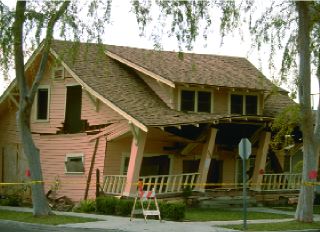 The latest evidence that earthquakes in the United States are not a matter of concern only in California was the occurrence on April 29, 2003, of a magnitude 4.9 quake, centered in Alabama. It rocked parts of Georgia, Kentucky, Mississippi, North Carolina, South Carolina and Tennessee. Cracked chimneys and foundations, broken dishes and power outages surprised people who had never known such an experience.
This event and other recent earthquakes throughout the country provide an additional reason to remind insurance buyers of the earthquake exclusion in basic property insurance and options for protection against earthquake property loss.
In general, homeowners policies, commercial property building and personal property coverage parts, and businessowners policies do not cover property damage caused by "earth movement," including earthquake. The "earth movement" exclusion in commercial policies is virtually identical to that in homeowners policies. The ISO commercial property causes of loss forms and the AAIS homeowners forms are representative. Other comparable forms of basic property insurance contain similar provisions.
For the most part, insurers of homes and businesses that offer earthquake coverage do so by endorsement of basic property insurance. ISO's Earthquake Form CP 10 40, for example, is available for use only with the basic, broad and special causes of loss forms applicable to commercial property. AAIS's Endorsement ML-54, by way of example, attaches to homeowners policies.
The endorsement process has minimized adjustment problems in terms of which coverage applies--fire or earthquake. Determination of what part of a loss was caused by fire is less a concern when both perils are covered by the same insurer, in the same policy, for the same amount of insurance. Having a single adjuster or claim office for a claim involving both earthquake and fire is a major factor in getting the job done relatively quickly and with a high degree of insured satisfaction, whether the earthquake peril is covered by endorsement or separately.
Recent rumblings in the earth have set the stage for getting the insurance message to property owners throughout the country, particularly those who have not had the experiences that are familiar to California residents. In addition to the quake of April 29, 2003, that was felt in seven southeastern states, the following may be cited:
* April 21, 2002. A magnitude 5.1 earthquake, centered near Plattsburgh, New York, collapsed parts of several roads in the state and left cracks in chimneys and foundations in the northeast region from Maine to Maryland.
* June 19, 2002. A moderate quake with a magnitude of 5.0, with its epicenter near Evansville, Indiana, was felt throughout Indiana and in Illinois, Kentucky, Missouri, Ohio, Tennessee and West Virginia.
* January 31, 1986. A quake with a magnitude of 5.0 to possibly 5.4 in some areas shook nine states from Washington, D.C., to Wisconsin. There were cracked windows and walls near its Lake Erie epicenter, including in Cleveland.
* November 9, 1968. The strongest earthquake recorded in the Midwest and South in recent years occurred on this date and was felt in 23 states. It was centered in south central Illinois and had a magnitude of 5.4.
The New Madrid (Missouri) fault is considered by the U.S. Geological Survey to be a major threat for earthquake activity in the eastern part of the United States. A series of quakes around New Madrid, Missouri, in 1811 and 1812 shifted the ground so drastically that the flow of the Mississippi River reversed for a time. The ground shook as far away as Washington, D.C. It is believed that a similar quake today could cause devastation in now highly developed parts of Illinois, Indiana, Kentucky, Missouri and Tennessee.
The earthquake exclusion in basic property insurance is comparable to the flood exclusion in that each of the perils is capable of generating enormous damage but is not an everyday occurrence.
Insurance industry organizations, individual insurers and their agents and brokers have done an effective job of informing the insurance buying public of the flood exclusion and the availability of insurance under the National Flood Insurance Program. Agents and brokers, in particular, can perform a similar and significant service by discussing the earthquake peril, policy exclusion and protection options with their insureds.
Homeowners insureds, in particular, will be interested in learning that a scheduled personal property endorsement, optionally attached to their policies, covers scheduled items against many perils not covered basically by the homeowners form, including earthquake. The same protection is provided under a separate personal articles floater.
The following classes of property are eligible for scheduling: jewelry, furs, cameras, musical instruments, silverware and goldware, golf equipment, fine arts, stamp collections and coin collections. Scheduling is intended for objects of high value. Keeping in mind that breakage is included in the broad scope of scheduled property coverage, the value of this protection is clear if fine arts of exceptional value are scheduled and an earthquake occurs.
Whether adding earthquake coverage by endorsement to a commercial property policy or to a homeowners policy, it is essential to become familiar with the underwriting requirements of the particular insurer.
In any event, acquainting insurance buyers with the earthquake exclusion is a very worthwhile undertaking in the vast areas of the country where the risk has not been a common concern. No one in our industry wants to hear insureds, upon the occurrence of a major loss of any kind, say that they were never told that coverage was not included or that it was unreasonable that they should know. Many will not choose coverage when informed of the particulars, but the insurance counselor will maintain a professional image.
Property loss caused by earthquake is specifically described in IRS rules as qualifying for deduction in personal income tax returns. This is welcome information for an insured who has suffered such a loss but was not covered. But it does not rank with receiving an insurance check to pay for replacement of personal belongings or for rebuilding. *
 The author
Roy C. McCormick is consulting editor of the Policy, Form & Manual Analysis Service (PF&M) published by Rough Notes.