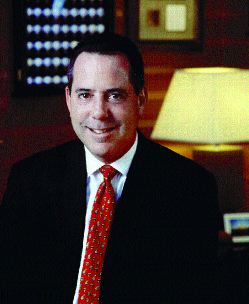
The right mix of underwriting, agent/company relationships, and internal checks and balances has proven successful for Metro Insurance
By Phil Zinkewicz
"As a retail agent, I saw a great many flaws in the wholesale insurance marketplace ... Our entire focus was, and still is, to form on-going relationships with the retail agents."
--Steven R. Gross, chairman/CEO, Metro Insurance Services, Inc.
In today's hard market, retail agents and brokers and even some managing general agents (MGAs) may be having a difficult time getting just the right insurance coverage they need for their hard-to-place clients. Even before September 11, the property/casualty insurance marketplace had been tightening up, and that horrific event exacerbated the situation. Moreover, a great many people in the insurance industry are too young to remember the last hard market of 1984-85, and so this new market is a learning experience for them.
Steven R. Gross, chairman and chief executive officer of Metro Insurance Services, Inc., remembers the last hard market. He started his retail agency in 1983, representing both national stock and regional companies. As difficult as those times were, he survived and learned a great deal. During that time he recognized a need within the industry for a more enhanced wholesale presence. In 1990, he sold his retail business and began to focus on developing a wholesale operation with a different variation.
"As a retail agent, I saw a great many flaws in the wholesale insurance marketplace," says Gross. "Many wholesalers just didn't understand the needs of the retail agent. I noticed that many wholesalers were acting like the U.S. postal system. When I sent them a piece of business, they just forwarded it on to their carriers, without taking the time to examine the risk carefully, ask questions and put together the right kind of submission before sending it off to the best carrier for the exposure. So, I stopped being a retail agent and became a wholesaler for retail agents. Our entire focus was, and still is, to form on-going relationships with the retail agents working with them while offering them advice on how to handle and sell an account."
Today, Metro represents United National, Lloyd's of London, and Burlington Insurance Group as a managing underwriter. Metro brokers business to American International Group, Fireman's Fund, First Specialty Insurance Corp., Granite State Insurance Co., Greenwich, Gulf Insurance Co., Indian Harbor Insurance Co., and Royal Specialty, among other insurance companies.
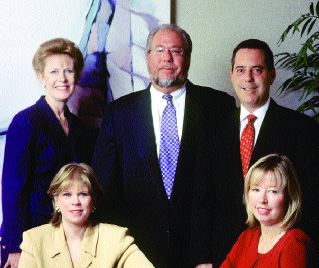 Metro Insurance Services, Inc., executives include: (seated from left) Linda M. Montalbano, executive vice president; Barbara J. Gross, chief financial officer; (standing from left) Maryanne O'Connell, CPCU, ARM; Arthur R. Petzel, Jr., vice president; and Steve Gross.
With offices in New Jersey, New York and Pennsylvania, Metro is reaping the benefits of steady, well-planned expansion and is consistently poised for future opportunities, according to Gross. Metro's Chief Financial Officer, Barbara J. Gross, a retired CPA, is responsible for all accounting matters including fiscal management.
In its New Jersey office, Gross's staff deals strictly with retail agents, and they offer MGA/binding authority as well as brokerage facilities. The split, Gross says, is about 65% underwriting and 35% brokerage. Metro's niche market is property and liability for lessors real estate risks including but not limited to apartments, condominiums, office buildings and mercantile accounts. The company also has a BOP program for office, retail, service and wholesale businesses which is available in most states.
Gross says that, whatever the account, Metro has an underwriting philosophy of building relationships one risk at a time. "We examine each individual risk and its characteristics. The more complete the information the client provides us, the faster we can turn a quote around. Working in partnership, we don't just quote the account for their agents; rather, we underwrite it along with them. In essence this is what makes the difference."
From the mundane to the unusual, large or small, Metro has the ability to meet its agents' needs, says Gross. "Writing risks such as builders risk, hotels and motels, laundries, restaurants, shopping centers, taverns and bars, theaters, caterers, air-conditioning manufacturers and dealers, asphalt works, billiard or pool halls, bowling lanes, to name a few, day-in and day-out experience comes with the territory. In addition, we write property insurance, both primary and excess, on vacant buildings and industrial properties, including warehouses."
Asked to describe market conditions in today's insurance environment, Gross commented: "Insurers are trying to recoup what they lost during the prolonged soft market, so prices have to rise and terms and conditions are getting tougher. Add to that the slow economy, the devaluation of the equities markets and the extremely low interest rates, and you have a formula for disaster unless carriers realize underwriting profits. I think we're finally seeing a time when the concept of cash flow underwriting has disappeared." He notes that while coverage is more difficult to place overall, the property arena in particular is "most difficult, especially in areas that are depressed and which were underpriced for so many years."
To that end, Metro capitalizes on the underwriting strength of Arthur Petzel, vice president of its property division. Petzel joined Metro in 1999, establishing a "unique" property underwriting hub in Pennsylvania, says Gross. "An underwriter with
25 years of insurance company experience, Arthur not only brought knowledge to the table but also a tried and true following of wholesale agent relationships."
 Arthur Petzel (left) joined Metro in 1999 and established a property underwriting hub in Pennsylvania. Linda Montalbano (right) is responsible for managing Metro's offices with an emphasis on marketing and production. Steve Gross founded Metro Insurance in 1990 after owning a retail agency.
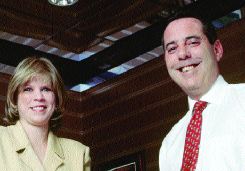
Gross seized an opportunity to diversify by opening up a Pennsylvania office run by Petzel specifically for these wholesale relationships. "Wholesalers come to us because we have the capacity they need," says Gross. "With binding authority on behalf of Lloyd's of London and United National to write up to $50 million in property limits, the results have been tremendous. There are very few agencies in the country that have anywhere near that amount. Because of Art's experience as an underwriter, he works with other wholesalers who cannot write the limits they need by themselves," says Gross.
In the late 1990s, Metro took a leap into the national arena by entering into a limited partnership with Frontier Insurance Group. As the referral agent for all non-program business nationwide, Metro significantly expanded its geographic territory. "Although Frontier ultimately experienced its financial difficulties, we had already established a nationwide presence in the market-place. This, combined with our ability to place this business with our other facilities, catapulted us to a higher level," says Gross.
Gross says that Metro's entrepreneurial spirit has brought it success through a combination of "doing the right thing" on the underwriting side, establishing and enhancing relationships with its agent base, forging company relationships and keeping an eye on production and the bottom line. And that's where Linda M. Montalbano, Metro's executive vice president comes into the picture.
Montalbano is in charge of overall management of all Metro offices with an emphasis on marketing and production. According to her, Metro is very select in choosing its partners. "Simply stated, we look for agencies that are interested in placing good risks and providing value-added services for their clients," says Montalbano. "We want agents that are dedicated to building their book of business with us, and I mean 'with us.' We don't want just be a clearinghouse for insurance risks. We want to write the business along with the agent.
"Our agent base ranges from the small company to the middle market agency and the very large agency," she continues. "It would be difficult and unfair to demand a certain premium volume production on the part of all agents. If there is a consistent flow of business and a continued synergy between us and the agency, then all will profit and the insured will be well served."
For insurance to value information, Metro uses a nationally recognized cost-estimator property program. Says Gross: "Basically, the program takes some of the characteristics of an exposure--if it's a building, the type of construction, the features, the age of the building, the number of stories, etc.--and then, based on ZIP code and square footage, develops the insurance replacement cost of that building. When someone sends a piece of business to be insured for a certain amount, we do an analysis and send him or her a cost estimator. While the cost estimator is not a replacement for a certified appraisal it serves the purpose of recognizing substantially under-valued risks."
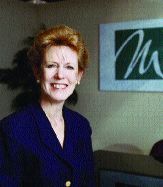 Maryanne O'Connell handles internal operations, including processing functions.
With underwriting and production on one side, stringent internal checks and balances help to balance the other side of the "Metro scale" out, says Gross. Mary Ann O'Connell, CPCU, ARM, is Metro's vice president in charge of internal operations. Responsible for all processing functions including claims management, O'Connell says: "All of the functions at Metro Insurance Services are computer-based. One system is designed for accounting and management, and the other is a proprietary system that we've developed to issue policies and deal with everyday operations and claims. Our computer operations are designed to assist our agent clients making their jobs and ours more efficient and easier to deal with."
For all of this, and serving on the board of the New Jersey Surplus Lines Association and NAPSLO Technology Committee, Gross is a pretty busy man. In addition, he has now partnered with one of his retail producers to form TMR Risk Managers, Inc. This retail division specifically deals with a controlled book of real estate business, and is designed not to adversely conflict with Metro's other divisions.
Adding to this mix and certainly most important for any company is the dedication of Metro's employees, says Gross. "Their expertise, professionalism and dedication are a credit to the company in which I take great pride."
With all this in mind, Metro Insurance Services appears to be well positioned to deal with the current hard market. "It's tough out there," says Gross. "But we believe that our strong entrepreneurial relationship with our producers and the commitment on the part of our carriers, which remains strong, we will remain profitable and continue to provide markets for hard-to-place and unique exposures now and in the future." *