Study finds that new terrorism law
generates more questions than answers
By Phil Zinkewicz
"On balance, the market is significantly more stable with TRIA than without it. However, cost and availability of coverage remain key issues."
--Ken A. Crerar, President
Council of Insurance Agents and Brokers (CIAB)
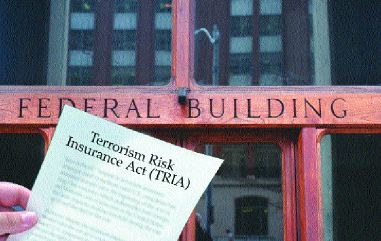
Following the horrific events of September 11, insurers were faced with the certainty of massive claims payouts, and the very existence of terrorism insurance coverage became threatened. Almost immediately, Congress began constructing some sort of terrorism insurance backup vehicle to encourage insurers to resume writing the coverage. It was some time in coming, but eventually, in the winter of 2002, Congress developed the Terrorism Risk Insurance Act (TRIA). At that time, not all of the "i's" were yet dotted or all of the "t's" crossed, and there is still a good deal of speculation as to how the law will play out in the event of another terrorist attack of the magnitude of the World Trade Center disaster.
Nevertheless, with the input of the insurance industry, the Treasury Department has been issuing periodic clarifications to iron out all of the remaining wrinkles. At the very least, those who want to buy terrorism insurance can feel a certain degree of comfort in the knowledge that coverage is available and at reasonable costs.
But is it?
According to Stephen Ashwell, terrorism underwriter for the London-based specialist insurer, Hiscox, the answer to that question is definitely "yes," although a recent survey of agents and brokers by the Council of Insurance Agents and Brokers (CIAB) indicates that the answer should be "depends."
Says Ashwell: "Interest in terrorism insurance amongst small to medium-sized U.S. companies has increased sharply since the beginning of the war in Iraq. Our company, which underwrites both foreign and domestic acts of terrorism in the United States, has seen inquiries increase five-fold during the run up to and the start of the war. However, despite the increased interest and steady market rates for our own cover, we believe there are many U.S. companies that are still finding it difficult to get the right cover against acts of terrorism. A recent survey carried out by the (CIAB) found that fewer than 20% of medium-sized accounts had purchased terrorism cover offered. There is a lot of uncertainty in the market. Many companies are experiencing difficulties getting the cover they need and are assuming there is no capacity as the prices are so volatile. This is simply not the case and businesses, especially the small to medium sector, should explore the terrorism market carefully."
Survey says
The CIAB study Ashwell refers to supports his contentions regarding a dearth of information regarding terrorism coverage. According to the survey, insurers are offering terrorism coverage; but many buildings, businesses and other commercial interests across the country are not buying the insurance because they do not consider themselves targets of terrorism, or the cost is too high, or both. Brokers queried in the survey noted, however, that in the days leading up to the war in Iraq, more businesses were buying coverage out of fear that terrorists could retaliate for U.S. actions in that region.
Nearly 60% of brokers responding to the survey said less than 10% of their small commercial property/casualty accounts and less than 20% of medium-sized accounts have purchased terrorism coverage offered to them by insurance carriers. Of the brokers handling large accounts, 48% said that fewer than one in five of the largest customers have bought terrorism coverage. The CIAB survey, conducted in the same manner as the Council's quarterly report on commercial property/casualty market trends, provides the first national sampling of the cost of terrorism coverage, according to the Council. Most of the small and medium accounts are being assessed 10% of premium, while large accounts typically pay 20% of premium.
But why isn't the coverage being purchased?
CIAB President Ken A. Crerar said responses of brokers to a number of open-ended questions indicate that, despite the passage of the federal terrorism insurance backstop at the end of last year, there are some significant gaps in terrorism coverage around the country. "On balance, the market is significantly more stable with TRIA than without it," he says. "However, cost and availability of coverage remain key issues. Small, relatively low-profile accounts seem to be able to find terrorism coverage at a reasonable cost, but many are opting not to buy it because they don't think they are at risk. On the other hand, some of the riskier operations, with real exposures, choose to do without coverage because of the cost."
Crerar says that there are a number of market challenges that remain. "The full set of regulations for TRIA implementation is not yet in place. So it is not altogether surprising that gaps in coverage continue to exist. We will watch the marketplace closely in coming months and expect more stability and predictability in time."
Under TRIA, insurance carriers are required to offer coverage for foreign terrorism and certified acts to their customers, but insurers must absorb a portion of the loss from acts of terrorism before the government backstop clicks in. The backstop does not include domestic terrorism.
The Council's survey indicates that, while carriers want to take advantage of the higher rates now being charged for commercial property/casualty insurance, they don't particularly want the added exposure to perceived terrorist targets. One broker in the Southwest responded to the survey this way: "They have shown concern for offering the terrorism coverage because they are not being reinsured in the existing marketplace, but they still want to write business and take advantage of the higher rates, so they are taking the risk net." Said another broker from the Southeast who handles large accounts: "When a carrier does not want the exposure, they are pricing the coverage at 100% of the property rate so that no clients elect the coverage." Another respondent to the survey said: "If there is a terror exposure, the coverage is difficult to obtain and expensive."
A broker from the Northeast said location of risk is key to the terror quotes. "Risks in Manhattan can run as high as 100% in the outer boroughs; out of the city, 5% - 10% of the property premium."
Rough Notes spoke with Richard Longueira, vice president of the Flushing, New York-based Petrocelli Group, who agreed that exposures in Manhattan are more likely to have difficulty obtaining terrorism insurance at reasonable prices. "On my smaller accounts, there is not an availability problem," he said. "But on one of my accounts, a high-valued apartment complex, we had to go to a less traditional carrier and the cost for terrorism coverage was 10% of the property premium ($3,200 on a property premium of $32,000). That was a $15 million apartment complex in Queens. Imagine if that exposure was in Manhattan.
"There are some companies that won't write any business in Manhattan, even basic property insurance," he continued. "They feel the market is pretty much saturated. When brokers have to go to the excess lines companies, that's when pricing gets really crazy," he said.
The CIAB survey showed that, in addition to cost and the belief that they are not vulnerable to terrorist attacks, another reason some commercial interests are giving for not buying terrorism insurance is that the coverage is not broad enough to do any good. Many large insureds don't believe that TRIA coverage is adequate for covering their exposures. Nuclear, biological agents exclusions negate coverage.
Another problem, according to the CIAB, is that TRIA covers terrorist attacks sponsored only by foreign interests, and CIAB survey respondents said many of their clients don't understand that. Brokers surveyed said the market for domestic terrorism is mixed. Some carriers are offering coverage--and, in some cases, coverage for no cost if the risk is not perceived to be high. But other carriers are excluding coverage if they can for the riskier situations.
Other concerns
Although 90% of brokers surveyed by the CIAB said they have not seen an appreciable increase in non-renewals, and an equal number said insurers are giving customers the option to buy terrorism coverage, some high-risk properties nonetheless are finding the market tight. One broker in the survey said that carriers are managing their limits "down to the block," or refusing to quote if the hazard is a high risk." Another broker said his non-renewals have involved "proximity to high-rise, high-visibility properties, such as government buildings or in high-risk areas."
Says Ashwell of Hiscox: "There is no doubt that there is confusion out there in the marketplace regarding terrorism insurance. There are some insurance companies in the United States that have no appetite for writing the coverage, but they have to offer it under TRIA; so they price the product so high that nobody will buy it and it is assumed that terrorism coverage is too expensive throughout the marketplace. But we are offering the coverage both foreign and domestic, and other companies such as AIG and Berkshire Hathaway are, as well. So are some Bermuda companies. Buyers must search the marketplace to find the right coverage they need. And their brokers must assist them in this regard. Hiscox provides terrorism cover via surplus lines brokers in the U.S. For smaller to medium-sized risks, Hiscox has developed the Terrorism Insurance Extranet, launched in August of last year. The system provides access to cover against foreign and domestic acts of terrorism for U.S. companies requiring cover of up to $25 million per building. The online Extranet system delivers instant quotes and policies and provides cost-effective insurance cover through major UK brokers and U.S. partners," says Ashwell.
So, according to Ashwell, terrorism coverage is available in the marketplace despite the chaos that the CIAB study indicates. It's apparently up to independent agents and brokers to not give into the chaos and just look a little harder. *