Chubb Health Care offers a number of specialty
products to medical providers
By Dennis H. Pillsbury
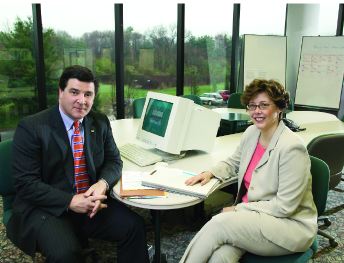
Chubb Health Care Group Senior Vice Presidents Paul F. Romano and Susan R. Huntington, JD, sit at one of the many collaboration tables at the company's office in Simsbury, Connecticut.
When the largest writer of medical malpractice left the field and a number of other med mal specialists found themselves in financial difficulties, it raised a lot of questions about the viability of that particular line of business. Then we had doctors striking in several states and atrabilious prognosticators intoning words of doom that even resonated in the ears of some members of Congress, well known for their selective hearing, who apparently are willing to consider some form of medical malpractice tort reform.
Meanwhile, Chubb Health Care, Simsbury, Connecticut, has been successfully writing or, more correctly, underwriting medical malpractice since 1997, when it entered the field.
"We think that one of the keys to our success has been our focus on very deliberate underwriting," says Paul Romano, senior vice president and managing director. "We use a very heavily engineered model evaluating class, size, jurisdiction, organizational track record, management continuity and several other criteria. In addition, we employ a collaborative approach among underwriters to assist in assuring that we've looked at all the angles and to improve our overall judgment on an individual risk."
He explains that the health care book is written by a team of underwriters, some coming from other companies and some trained in-house. "By bringing these talented experts together, we have a much better chance of selecting risks we like and pricing the product properly."
Susan Huntington, senior vice president and Health Care product manager, adds, "As a corollary to that collaborative approach in underwriting, we also collaborate across disciplines. Underwriting, risk management, loss control, actuarial and claims all talk to each other whenever something occurs that might change the nature of the underlying risk. For example, when claims start coming in, the claims person will bring that to the attention of other areas. This gives us the ability to quickly address the issues that are arising in our book."
She continues by noting that "diversification also is a key factor in helping us achieve a profitable health care book. We don't just write medical malpractice. In fact, medical malpractice represents only about 30% of our health care portfolio, with managed care E&O accounting for 21%; D&O 33%; provider excess 13%; and miscellaneous 3%."
Paul adds, "Diversification also helps because some of the lines we write for health care organizations are counter-cyclical so when one coverage temporarily turns sour, the others provide a positive balance while we correct the situation. We always underwrite with the expectation of making a profit, but there are times when one line just isn't cooperating. Our diversification helps us weather those times better."
Deep experience
"Another part of our secret of success is our people," Susan says. "We have many people who have worked in the health care industry--some for 25 years or longer. We have nurses and health care attorneys; we even have seven risk managers with health care backgrounds who visit our insureds to observe the quality of the organization being insured. Our goal is to do business with the best- performing health care organizations. We audit their processes and the quality of their oversight."
Paul elaborates, "We consider ourselves a stakeholder in the complex business of health care and want to be deeply involved with each of our insureds. Our producers understand that this ultimately benefits the insured since we work with them to determine the best way to mitigate risk. We are attempting to act as an extension of their efforts to stabilize the cost of risk over time. Our interest is in being an ally not a policeman.
"As an ally, we attempt to meet with every insured and try to help them understand how our interests and theirs are aligned. We want to work with them to determine what risks they can keep, what risks they can mitigate and what risks need to be transferred. Once that is determined, we offer a range of options that can be used to respond to their risk transfer needs."
In what appears to be a strange anomaly, Susan points out, Chubb is able to provide quick turnaround on renewals precisely because it spends so much time on the process. "We use our collaborative underwriting approach to all lines and begin a multi-disciplined overview of the insured about 120 days before renewal. That way there are no surprises and we don't get jammed up at the last minute.
"We also offer alternative risk transfer (ART) solutions," Susan says, "that run the gamut from high self-insured retention levels to captive or self-insurance arrangements." Chubb introduced ART for health care organizations this year.
"This also allows us to remain in the field when the market softens," she adds. "We don't intend to get caught in the pricing trap if overly competitive pricing returns, but we'll certainly be able to continue to offer ART solutions that will be attractive to health care organizations that are looking for excess coverage from a quality insurer that has been a consistent player in this market."
"Skin in the game"
One indication that a health care organization has an effective risk management program in place is its willingness to accept or self-insure part of the risk. "We always look for entities that are willing to have some 'skin in the game,'" Susan says. "That's part of the reason we don't write individual physicians. They usually look for first-dollar coverage or something pretty close to that.
"In many ways, this market is analogous to the health insurance industry," she notes. "Early on, health insurance was written to cover catastrophes and has since evolved to first-dollar coverage. We're now starting to move away from that and back toward catastrophic coverage where the insured takes on more responsibility for managing care and cost-of-care needs. The same thing has happened in medical malpractice, where coverage initially was written on a catastrophic basis and then, as the market softened, became a first-dollar coverage. Today, it's heading back to being written on a catastrophic basis."
Stability and quality
Paul concludes, "Our job is to work with our insureds to stabilize the cost of risk over time. To accomplish that, we need to have our interests aligned--a true partnership. We need to find effective ways to provide a risk transfer product at prices our insureds can live with for those coverages that can be insured, as well as help them self-insure and mitigate other aspects of risk.
"We understand that it can be difficult to find solutions that work for us and for our clients during this hard market. Though some clients have expressed frustration as insurers struggle to return to profitability in the health care lines of business, we are rapidly headed to the point where we can see reasons to stick with this.
"As I mentioned earlier, our goal is to be an ally to our insureds. It is important to keep in mind that alliances are productive and sustainable when the interests of primary stakeholders are served. Our primary interest is a fair return for Chubb shareholders in exchange for the important protections and value-added services we offer health care organizations." *

* Small and medium-sized hospitals
* Small and medium-sized clinics
* Medical groups with more than five but fewer than 50 providers
* Ambulatory surgery centers
* Rehabilitation facilities
* Hospice organizations
* Diagnostic treatment centers
CHUBB'S EXCESS COVERAGE TARGETS
* Any size hospital or clinic
* University or academic medical centers
For more information:
Chubb Group of Insurance Companies
Contact: Paul Romano or Susan Huntington
Phone: (800) 432-8168
Web site: http://csi.chubb.com