RISK PROBLEMS/SOLUTIONS
By LeRoy H. Utschig, CPCU, ARM
UNTYPICAL COVERAGES
Anticipating the need for an unusual coverage is good insurance
 The purpose of this article is to familiarize you with several policies that you may not be in the habit of discussing with your clients. You might have only one or two clients that need any of these contracts. As an agent, it could be very easy to generalize and say, "None of my clients need any of these coverages." The decision to buy or not to buy coverage, however, is always the client's. You should make your clients aware of possible exposures and the availability of these coverages and then give them the choice of saying, "Yes, I want this coverage," or, "No, I don't want this coverage."
Directors and officers
Several brothers and sisters obtained control of a $1 billion insurance company. They proceeded to take enough money out of the firm to cause it eventually to go into bankruptcy. During this process, one of the sisters became dissatisfied with the amount of money that she was getting. She sued the brother who was in charge. While it was an unusual situation, the firm's directors and officers liability coverage responded.
A small farm machinery manufacturer located about 40 miles north of Milwaukee experienced an average growth of 14% per year and was making a profit. A couple of investors bought a small portion of the firm's stock. These investors proceeded to make a lot of trouble. They didn't want consistent profits because their intent was to force the company to sell to someone else. This was part of their scheme so they would be able to raid the company, take all of the money out and bankrupt the firm.
The investors brought a claim against management stating that the management was refusing to maximize their profits. Directors and officers (D&O) liability coverage responded to this claim. Without directors and officers liability coverage, the lawsuit by the two stockholders would have forced the firm into bankruptcy. It is very expensive to defend a D&O claim. It is not unusual for the cost of defense for D&O to be $1 million. While this machinery manufacturer was making a profit, it did not have an extra $1 million lying around to defend a D&O claim. It is thought by some that the principal reason for buying D&O coverage is to pay for the cost of defending a claim.
Contractors ripping and tearing insurance
Construction, Inc., had completed the construction of an apartment house complex, Apartments, Ltd. Within a year, tenants were complaining that the drywall was sagging and coming loose. The landlord was not too concerned when the first tenant complained about this. After all, complaints from tenants are part of renting out property. When he began to receive the same complaints from other tenants, he took notice and looked at several apartments in each of the buildings in the complex. The drywall had to be fixed.
 Apartments called Construction and instructed them to fix the loose drywall. On further inspection, it was determined that all of the drywall would need to be replaced. Construction's general liability carrier refused to pay for any of the repairs. Their ripping and tearing insurance paid for labor costs involved with the repair job. The ripping and tearing insurance did not cover material costs of the repairs.
Owners and contractors protective liability
Building Owner, LLC, contracted to have a new heating and air-conditioning unit installed. Hot and Cold, Inc., was the firm selling and installing the equipment. The original equipment had been installed in the basement. However, it was so large that it would be necessary to demolish a part of the building in order to remove it. Building Owner and Hot and Cold decided to let the old equipment remain in the basement and to put the new heating and air-conditioning equipment on the roof.
While a piece of the equipment was being hoisted to the roof, one of the cables became frayed and broke, causing more weight to be held by the remaining three cables. Then, a second cable began to slowly unravel and finally broke. The remaining two cables became over taxed by the remaining weight; however, they did not unravel and then break. Instead, they instantly snapped and the machinery dropped to the ground. Pieces flew everywhere.
Although Hot and Cold had put up barricades to keep pedestrians away from the danger zone, an elderly lady ignored them. Paying no attention to the "keep out" signs, she walked around the barricades and was hit by one of the falling pieces of machinery. She hired an attorney and sued.
Hot and Cold had a general liability policy, as did Building Owner. Their respective policies would respond to the claim. However, there was another policy in force, one that is not commonly used--an owners and contractors protective (OCP) liability policy. This policy named Building Owner as being protected by the OCP for the actions of Hot and Cold. An OCP contract is very narrow in its scope of coverage. The firm to be protected must be named (Building Owner) as well as the firm whose actions might cause an injury (Hot and Cold). Typically, we are talking about a subcontractor situation causing the need for OCP.
Many times there is a minimum premium charge for this coverage. Only once in 35 years did I make more than a minimum premium charge for OCP coverage. It is worth noting that using an OCP did not eliminate Building Owner's need to have general liability coverage. It might be helpful to think of owners and contractors protective liability coverage as extra coverage in addition to normal insurance programs.
It is possible that Building Owner could be named as an additional insured on Hot and Cold's general liability policy. There might even be a hold harmless agreement between the two parties. Both of these methods presume that Hot and Cold will have its total policy limits for a claim against Building Owner. There is an annual aggregate limit on the commercial general liability contract as part of Hot and Cold's insurance program. Hot and Cold could have a claim(s) from a different loss that would reduce their liability insurance limits. The other loss could result in less than full policy limits being available to Building Owner. Only by having an OCP in force can Building Owner have full protection from the subcontractor's negligence.
Railroad protective liability
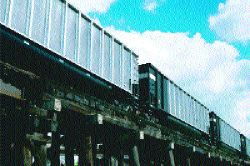
A South Dakota farmer built a grain elevator over a railroad track. The railroad wanted a certificate of liability insurance that stated he had railroad protective liability insurance. Probably the most common way of handling this situation is to secure a railroad protective liability contract from a specialty market. Many insurers do not provide this coverage. Some insurance companies will provide railroad protective liability for their very large accounts but will not do so for average-sized accounts.
There will be times when a railroad will ask for railroad protective liability when it really is not needed. Demonstrating to the railroad protective liability (RPL) insurer that there is minimal or no exposure may make it easier for you to secure RPL coverage and secure it at a better price. Here is a true case where an insured needed to provide railroad protective liability even though there was coverage from the insured's general liability contract.
 Landscaper, Ltd., secured a job mowing grass on a plot of land that ran near close to railroad tracks. In fact, it ran onto the railroad's right-of-way and right up to the beginning of the stone ballast that gives a firm foundation to the tracks. Landscaper had coverage under their general liability insurance if they caused injury to railroad property. The railroad would not accept this explanation. Therefore, Landscaper purchased a railroad protective policy to satisfy the railroad's insurance requirements.
Environmental impairment liability
Darkroom, Ltd., had a darkroom for developing photographs. They were not in competition with firms that developed thousands of photographs each day. Their specialty was developing photos for the serious camera buff to enter in photography competitions. Many of them would be sold to individuals while others would adorn the walls of public buildings such as libraries and city halls.
As many as a dozen dangerous solutions can be used to develop a given photograph. In addition, the photographic film in the typical camera uses a form of silver that can be quite deadly in certain situations. There is not much of this silver compound in any one roll of film used by most people. However, developing the film and then putting hundreds of rolls of film in the same container can create a hazardous situation. Should a container of developed film catch on fire, the silver in the smoke could prove to be quite dangerous.
A silver compound is not the only dangerous item in the typical darkroom. More than one kind of acid is used, as well as several caustic basic chemicals. Usually, small amounts of these chemicals are being used at any one time. When a firm throws these chemicals away, it is not allowed to dump them into a sewer. Disposing of darkroom chemicals without using the sewer presented a problem to Darkroom.
Darkroom built what some people call a dry well. They dug a large hole in the porous soil on their property and lined it with medium-sized stones. The idea was to run the waste directly into the dry well. Due to the nature of the soil and the use of stones to dissipate the chemical waste, the chemicals would simply disappear when they were poured onto the stones. These liquids would run over the stones and then soak into the ground underneath. During their many years of operation, Darkroom poured countless gallons of chemicals down the dry well. This material soaked into the ground, going straight down. However, the hazardous waste also moved sideways through the soil.
No one, particularly Darkroom, had anticipated that the chemicals would leach sideways through the soil. Moreover, no one cared. The trouble started when Business Next Door, Inc., decided to sell. Because the prospective buyer didn't want to buy an environmental hazard, Business Next Door had several test borings done. Several of them tested positive for hazardous waste. A more detailed analysis showed that silver, acid and some caustic basic materials were in the soil. Because Business Next Door never used those types of hazardous waste materials, they looked around for the source.
One of the people checked Darkroom's operation, including the dry well operation. A government agency determined that Darkroom had caused the hazardous waste problem and that they would need to pay for the cleanup. This would involve hiring a hazardous waste contractor to dig out the contaminated ground and haul it to an approved hazardous waste site.
Because Darkroom had no insurance coverage to cover the costs-- which were more than they could afford--they filed for bankruptcy. Using an environmental impairment liability policy could have insured coverage for this exposure.
Summary
You may not have a client who needs any of the coverages discussed in this article. However, if you do not ask the questions, how can you be sure that a given client doesn't have one of these exposures? If you add these coverages to your commercial lines coverage checklist, you can ask any client about these exposures in less than five minutes. *
The author
LeRoy H. Utschig, CPCU, ARM, is a Wisconsin-based insurance educator, consultant and expert witness.