COVERAGE CONCERNS
By Roy C. McCormick
UNDERSTANDING FLOOD EXPOSURE AND COVERAGE
It is essential that agents brief their insureds
on the particulars of flood insurance
Flooding is the most common natural disaster. Sixty-one percent of all presidentially declared disasters in the last five years included flooding.
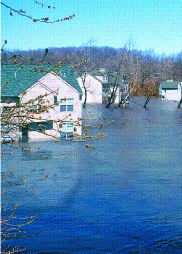 As a result of unusually heavy snowstorms this past winter and downpours of rain that have followed in much of the country, the stage is set for a discussion with clients about flood exposures. The following guidelines will help insurance producers and counselors inform insureds about the pertinent flood damage exclusions in basic personal and commercial property insurance and the protection available under the National Flood Insurance Program.
The effect of the exclusionary language in basic commercial and personal property insurance is that there is no coverage for damage caused by flood, surface water, waves, tides, tidal waves, overflow of a body of water, or spray from any of these, all whether driven by wind or not. Mudslide and mudflow are specifically excluded in some forms for clarification, although they are otherwise considered within the scope of the exclusion.
National flood insurance picks up the exposure by insuring direct damage to covered property caused by flooding. "Flood" is defined in the NFIP as "a general and temporary condition during which the surface of normally dry land is partially or completely inundated." It is a condition that at least two properties in the area or two or more acres must be affected. Flooding can be caused by:
* The overflow of inland or tidal waters
* The unusual or rapid accumulation or runoff of surface waters from any source, such as heavy rainfall
* Mudslides, meaning mudflows caused by flooding that could be rivers of liquid and flowing mud
* The collapse or destabilization of land along the shore of a lake or other body of water, resulting from erosion or the effect of waves, or water currents exceeding normal cyclical levels.
National flood insurance may be purchased by any property owner--business, residential or otherwise--provided that the community in which the property is located is a participating community in the National Flood Insurance Program. Fundamental to advising insureds on the subject is determining if their property is currently within a participating community. If that is so, insurance is available whether the property is in a high, low or moderate risk area.
A few statistics and facts demonstrate the need for flood insurance. Floods are becoming more severe because buildings, roads and parking lots are being built on land that was formerly forests and meadows. Flooding is the most common natural disaster. Sixty-one percent of all presidentially declared disasters in the last five years included flooding. Between 20% and 25% of NFIP's claims came from outside high-flood-risk areas.
The NFIP is the prime source of flood insurance for general property, both residential and commercial structures and their contents. However, significant flood protection is available, selectively, for specific classes of personal property and a limited number of structures. Notable are scheduled property forms, historically identified as inland marine insurance, usually covering perils except as specifically excluded. Flood damage is invariably included.
Among commercial inland marine forms available for businesses, governmental units, institutions and other activities of a non-personal nature are: transportation policies, contractors' equipment floaters, livestock floaters and bridge policies. Among the coverages for farming operations is crop insurance. Although crop coverage is purchased for protection against the perils of drought, freezing, hail or tornado, flood coverage is included under multiple-peril crop insurance. Crop insurance can be a lifesaver for a farmer whose fields have been inundated by floodwaters.
Regarding personal insurance, buyers of homeowners policies may supplement their protection with insurance for especially valuable classes or objects of personal property on a schedule basis. Subject to a limited number of reasonable exclusions, the forms clearly cover damage by surface water and flooding. Many such items of personal property have accounted for serious uninsured losses from floods and damaging surface water accumulation. High-value oriental rugs, for example, though prized by their owners and given good care, are frequently located on first-floor levels and are vulnerable to water damage.
Insureds who have experienced loss of or damage to private passenger automobiles and commercial vehicles from flooding especially appreciate their auto policies. The flood peril is covered under physical damage coverage of a personal auto policy when "other than collision coverage," a.k.a. comprehensive coverage, is in effect. It is covered under physical damage coverage of a commercial auto policy when comprehensive coverage is in force or by way of specified causes of loss coverage.
A home owner who suffers flood damage will be grateful to the insurance counselor who encouraged the preparation of an itemized inventory of personal property prior to the occurrence of loss. The inventory becomes even more valuable when it is augmented by bills of sale and appraisals of valuable items. A photo inventory is especially significant in establishing the condition and value of damaged property when it includes before and after shots.
The potential for flooding in 2003 is significant. Your clients will welcome information about the National Flood Insurance Program. When briefing insureds who are vulnerable to flood losses, agents and brokers should stress that flood damage is excluded under standard property insurance covering structures and their general contents, that emergency disaster relief is not universally available, and that it consists only of loans.
The National Flood Insurance Program is an important consideration for many property owners. Review of existing accounts, followed by personal discussion or contact by regular or e-mail, will not be perceived as a promotional "snow job" because the 2003 weather experience is fresh in their minds. *
 The author
Roy C. McCormick is consulting editor of the Policy, Form & Manual Analysis Service (PF&M) published by
Rough Notes.