
|
The Rough Notes Company |
|
 The 1940s was a decade of political and societal change. The December 7, 1941, bombing of Pearl Harbor by the Japanese forced the United States into war against Japan and Germany. Two-and one-half years later, on June 6, 1944, Allied troops landed in Normandy. D-Day, as it came to be known, signaled the final push toward victory. President Franklin D. Roosevelt died on April 12, 1945, just as World War II was entering its final phase. Vice President Harry S Truman took over the presidency. Just one month later, Germany surrendered; and in August, the United States dropped atomic bombs on Hiroshima and Nagasaki, bringing on Japan's surrender. The 1940s also saw the beginnings of racial change when, in 1947, Jackie Robinson broke baseball's color barrier. |
  |
 |
World War II created new business opportunities for independent agents. The American public was not buying auto insurance because of shortages in tire and car production, and the institution of gas rationing. Agencies that had relied on auto insurance for their primary income had to focus on other kinds of risks in order to stay in business during the war years. Just as auto insurance came to screeching halt, the growth of munitions factories and other defense projects brought new hazards and thus the need for insurance protection. In addition, because automobile-related shortages also disrupted agents' newest mode of conducting business, they had to find new ways to communicate with clients other than by paying personal visits. As the war progressed, agents began to rely less on the automobile and more on direct mail and the telephone. |
Rough Notes published
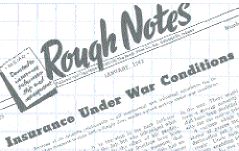
"Insurance under War Conditions," |
|
| "The telephone is man's best friend," says Ashby Rawls, of R. P. Rawls & Son.
Gas rationing and office help shortage is responsible for this tribute: "To offset Loss of Income from Automobile business this agency has found Hospitalization Insurance a good line to develop." "Accident insurance and Inland Marine have been income savers for the Lewith & Freeman agency," says LeRoy Landua, the manager. "We are urging customers to pay premiums at the agency." "G.C. Baxley, Alliance, used to deliver personally every policy renewal but, as this is no longer possible, he depends upon the post office to do the job. To eliminate office routine as much as possible he has printed a card ...
Dear Friend and Policy Holder: |
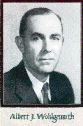 Albert Wohlgemuth, president of The Rough Notes Company, purchased Thomas & Evans, Capital Blank Book Company and Discomputer, with whom RN introduced the Universal Cancellator which is still sold today (called the Calculator Wheel). |
 |
|
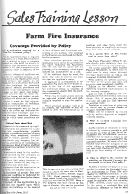
 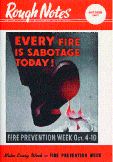 During WW II, Americans had to be more conservative in the use of many items that had been taken for granted. For example, because the U.S. government feared that the country would deplete its resources of paper before the end of the war, it asked businesses to conserve. In response, agent associations suspended most of their classes. The Rough Notes Company recognized that there was a need to keep inexperienced (and veteran) agents educated and updated on classes of hazards. Rough Notes magazine initiated a column called "Sales Training Lesson," which featured questions and answers. This was a huge commitment to the agent on the part of RN. The federal government had asked publishers nationwide to use less paper, and to reduce the size of their magazines by 25% by 1944. However, Rough Notes, acting as the champion of the independent agent, considered the education process important enough to give up editorial space. During WW II, Americans had to be more conservative in the use of many items that had been taken for granted. For example, because the U.S. government feared that the country would deplete its resources of paper before the end of the war, it asked businesses to conserve. In response, agent associations suspended most of their classes. The Rough Notes Company recognized that there was a need to keep inexperienced (and veteran) agents educated and updated on classes of hazards. Rough Notes magazine initiated a column called "Sales Training Lesson," which featured questions and answers. This was a huge commitment to the agent on the part of RN. The federal government had asked publishers nationwide to use less paper, and to reduce the size of their magazines by 25% by 1944. However, Rough Notes, acting as the champion of the independent agent, considered the education process important enough to give up editorial space.
The U.S. was hit with nasty weather as well. For example, Kansas reported 26 tornadoes in 1942, one of which followed an 88-mile long path, causing a property loss of $220,000 and three deaths. The Crowell, Texas, storm caused a loss of $1.5 million. Minnesota reported five tornadoes and 15 especially violent windstorms that killed livestock, and demolished houses and barns at a cost of $2.3 million. And in Oklahoma, a tornado caused property damage exceeding $2 million and killed 52 people. |
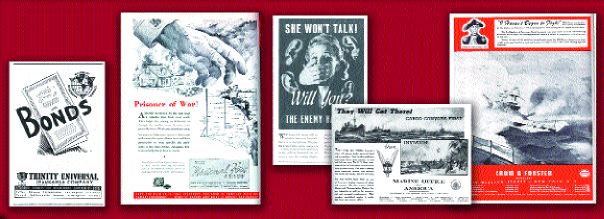 |
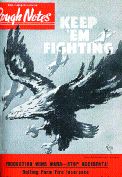
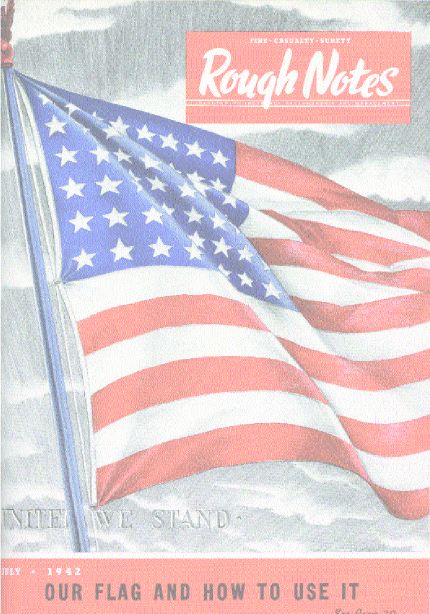
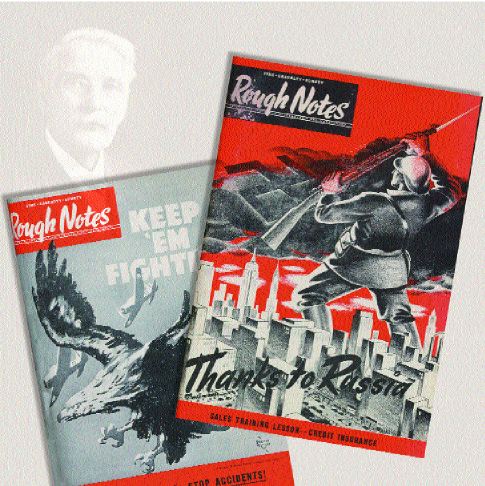
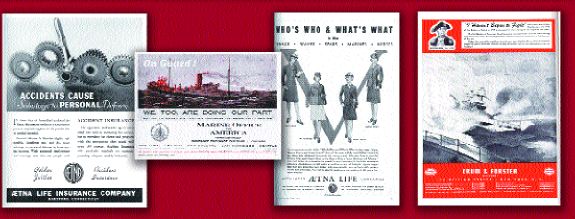
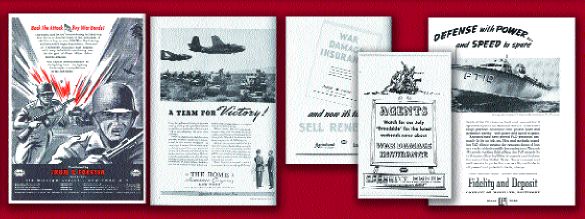
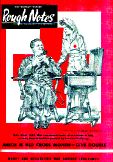 Rough Notes employees energetically joined the war effort on the home front. After the bombing of Pearl Harbor, Rough Notes magazine covers became patriotic in nature--at least 95% of RN covers depicted war scenes. Most insurance company ads featured combat scenes and headlines trumpeted, "Back The Attack With War Bonds!" or "Ready for Action Anytime Anywhere." RN's activities included employee-run committees to collect war bonds, stamps and small gift for soldiers. But the most impressive act was their call for "books, games, musical instruments, athletic and gymnastic equipment, and records for prisoners of war." Rough Notes employees energetically joined the war effort on the home front. After the bombing of Pearl Harbor, Rough Notes magazine covers became patriotic in nature--at least 95% of RN covers depicted war scenes. Most insurance company ads featured combat scenes and headlines trumpeted, "Back The Attack With War Bonds!" or "Ready for Action Anytime Anywhere." RN's activities included employee-run committees to collect war bonds, stamps and small gift for soldiers. But the most impressive act was their call for "books, games, musical instruments, athletic and gymnastic equipment, and records for prisoners of war."
|
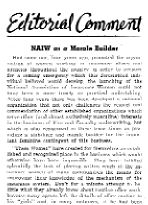
 WWII provided opportunities for women in the insurance industry. Women were trained for the first time in under-writing, accounting, reinsurance and other nontraditional jobs. As noted in a 1941 Rough Notes magazine: "In many local agencies, already, women members of the staff have had to assume duties of men who have been called into military service and for not a few of them the new responsibilities have not been so difficult because they have had the benefit of educational courses through the National Association of Insurance Women." |
 |
|
 The war years also brought huge financial losses to property and casualty lines. There were so many fires and industry accidents during this time that President Roosevelt considered them to be a war hindrance and called on the National Safety Council to lead a nationwide wartime emergency campaign.
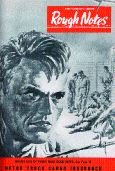 A 1943 Rough Notes editorial stated that: "the important issue is to keep the prisoners, during their unemployed hours, provided with the means for study, recreation and entertainment. Without such facilities, the morale of prisoners is bound to break and irremediable injury is done." They asked agents to donate to the National War Prisoners' Aid of the World's Committee of the Young Men's Christian Associations. To dramatize the need for this kind of additional aid, a RN employee, who joined the front lines as a Post magazine photographer, created a line drawing of prisoners of war for a Rough Notes cover.