A moderate approach to scanning reduces E&O
exposures and eliminates workflow headaches
By Nancy Doucette
"Agents need to understand they don't have to scan
everything in order to be technology adept."
--Virginia Bates, VMB Associates, Inc., Melrose, Massachusetts
"Moderation in all things." --Terence Roman playwright
Technology buzzwords often start out as a low-pitched hum and in short order, the decibel level increases. The decibel level has been increasing recently about scanning. According to scanning proponents, scanning can increase profits and reduce the need for square footage and filing cabinets in which to store paper documents--certainly attractive notions for agents. But then come the workflow questions: What gets scanned, when does it get scanned, and who scans it?
"Scanning is a lot like alcohol consumption," quips Melrose, Massachusetts-based management and automation consultant Virginia Bates. "A little bit is heavenly, and too much can ruin your life." Bates, through her consulting firm VMB Associates, Inc., has worked with a host of agencies on profitability, reducing E&O exposure, operations, and successful automation. When the subject of scanning comes up during a workshop or client visit, she points out that there are two basic approaches to scanning: wholesale and strategic. With the wholesale approach, the agency scans all its files--the wheat and the chaff. Strategic scanning, she says, can bring agencies to that heavenly place. In other words, a moderate approach brings the best results.
"With strategic scanning," she explains, "agencies create images of only the information they really care about. In the wholesale approach, the inference is: 'We care about all paper.' In reality, agencies should be caring about and using practically none of it. Agents need to understand that they don't have to scan everything in order to be technology adept. Wholesale scanning makes people more dependent on paper because it makes all that paper accessible to people right on their desktop."
Bates sees this as a step backward, given that transactional filing (T-filing) was conceptualized some 20 years ago to reduce an agency's dependency on paper, and to encourage greater reliance on the agency management system database as the source for client information. "Wholesale scanning defeats the purpose of creating a consistent, accurate database," she says.
Additionally, wholesale scanning violates the single source rule which comes out of the E&O carriers' recommendation that every agency have one information source. In an automated agency that single source is the database in the agency management system. Bates says that the E&O carriers actively dissuade agencies from having alpha paper files. "All that's in the paper file is a duplicate of what's in the system," she notes, "and if there's any inconsistency between the two, an opposing counsel can utilize that to advance his or her case. The E&O carriers quite logically say: 'If you're going to be automated, be automated. And if you're going to be all paper, then be all paper. But choose.' A consultant will come in and say, if you have to choose, choose technology because you'll be more profitable that way."
But if the scanned image is in the computer, isn't it part of the automated system and therefore in keeping with the single source rule? Bates says no, because that scanned image is in a different format from the rest of the data in the agency management system and, therefore, could be construed as violating the single source rule. What's key, she notes, is that the scanned image is used to supplement what's in the database. Scanned material shouldn't be a substitute or an alternative to what's in the database.
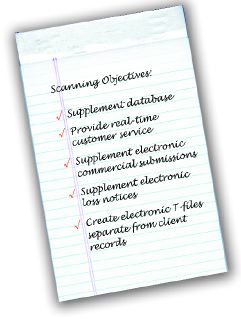
Bates recommends that agencies consider the benefits that scanning brings by looking at scanning strategically as opposed to scanning all the paper. Strategic scanning breaks down into three elements:
Scan and attach. This element focuses information that supplements the database but which can't be in the database because of system limitations, and is important to managing the account. It's a short list, she says, which includes: business income worksheets, manuscript forms and endorsements, controversial mod sheets (those that will cause discussions with the client and third parties), controversial audits, and complicated rating worksheets.
Bates points out that these documents will be needed on a repetitive basis to service the account. So once the agency has scanned and attached those documents to its electronic client record, when the customer calls to discuss that controversial mod sheet, for instance, instead of putting the customer on hold and going through the T-files, the service person can click on the image symbol in the agency's management system and see the mod sheet. "The service person is looking at what the customer is looking at--giving the customer real-time service," she explains. "Scan and attach allows real-time service, and it allows sit-in-the-chair service so the service person isn't running around tracking down paper."
Absent from the short list of "must scan" material are photographs, she notes. Pictures of buildings that accompany an application need to be current, so scanning photos should be avoided in order to preclude sending stale information to the carrier. "That can damage an agency's reputation with the carrier," she says.
Scan to send. This element focuses on those documents that must be attached to a commercial submission--loss runs, financials, photos--that don't reside in the management system like an ACORD application would. These images can be bundled with the applications generated by the management system and e-mailed or e-faxed to the carriers. This element also takes into account estimates and appraisals that need to accompany an ACORD loss notice in an e-mail or e-fax transmission.
Unlike scan-and-attach information, the scan-to-send information is not attached to the client files. "The agency won't need the information again for service," she explains. "So these items should be T-filed in their paper format. The management system will create an activity to indicate the day the information was sent to the carrier, and that's where it will be in the T-file."
Scan to T-file. This element focuses on a special situation where the agency doesn't have enough space to accommodate the paper T-files. Bates suggests that the agency "skinny down" its T-files before beginning to scan the documents. She explains: "The only documents that should be in the T-files are those that come from the outside world--a lost policy release from the customer, letters from the customer, engineering requirements--or signature documents that the agency should retain for legal protection--signed applications or signed state-required UM forms. This eliminates anything that's stored electronically in the system--binders, certificates, letters the agency sent."
Generally, once the agency condenses its T-files, there's ample space for the remaining paper. But in those instances where there simply is no room to store the paper T-files, Bates cautions agencies against attaching the T-files to the client records. "The point of T-filing is that you don't need the paper to service the account," she says. "Store it off site, so it's totally outside the management system and the service desks, and store it in the same order as you scan the paper--by date, by staff person. The only time you'd need to access that scanned T-filing is if you get sued and need to take an image to court."
From a workflow perspective, taking a strategic approach to scanning simplifies the scanning workflow. Bates explains that the three elements she identifies fit an agency's general workflow without slowing it down. The scan-and-attach and the scan-to-send elements can be done with a fairly inexpensive scanner at each service person's desk. The scan to T-file element can be handled by the administrative person who normally collects T-filing. It can be scanned in a batch with simple labeling by that person.
"You shouldn't have to hire a person to manage the scanning," she says. Some agents are, though, which causes Bates to remind those agents that the goal of technology is to maintain staff size, not increase it. "That's extra money out of the agency's bottom line, as opposed to increasing the agency's bottom line. That's why strategic scanning makes sense." *
Author's note: Virginia Bates presented a two-part session on strategic scanning at the 2003 Applied Systems Client Network Annual Technology, Education, and Networking Conference.