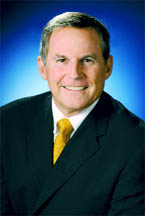
Don Hurzeler, CPCU, CLU,

By design and designation:
Hurzeler at the helm
by Bruce D. Hicks, CPCU
Don Hurzeler, CPCU, CLU, |
|
“I am Don Hurzeler and I’m proud to be a CPCU.”
With those words, Don Hurzeler, CPCU, CLU, of Zurich American began his term as president of the Society of Chartered Property Casualty Underwriters. His opening statement resonated throughout the crowd of CPCUs attending the General Session of the 2004 CPCU Annual Meeting in Los Angeles last October. The Society, with a current paid membership of nearly 27,000, officially ends each of its business meetings with the installation of new officers. After acknowledging his predecessor (Hugh McGowan, Sr., president of the McGowan Insurance Group in Indianapolis), Hurzeler appeared eager to begin his term. The CPCUs who made up the audience for his first speech as Society president appeared ready to accept the message he shared.
Hurzeler’s optimism and enthusiasm were particularly welcome after long days of seminars and networking opportunities where many insurance professionals discussed the effects of catastrophes—both natural (multiple hurricanes) and legal (the New York Attorney General’s investigation of bid rigging). Hurzeler’s talk focused on the reality that individuals are in charge of their professional lives, and on keeping a positive perspective. He also emphasized the importance of the Society, especially in its 60th year. To Hurzeler, the greatest value of the CPCU Society is the opportunities it represents, giving access to those with talent and experience who can assist others in their work lives.
Hurzeler’s high level of confidence and energy have been consistent components of his career. For several years he served as CEO and president of Zurich Middle Markets. He is currently president of the Zurich Foundation and senior vice president of sales/distribution for the Commercial Business Group in Schaumburg, Illinois. He believes that his career has thoroughly prepared him for his duties as the CPCU Society’s president because his leadership skills, especially those learned during his time with Zurich, are transferable to the tasks he will have to tackle on behalf of the Society. When asked what inspired his commitment, he observed that both Zurich American and the CPCU Society have similar views on the importance of handling insurance transactions ethically.
Industry ethics
The issue of ethics has become one of the property and casualty industry’s hottest topics in light of the various investigations involving alleged abuse of contingent commission arrangements. When asked about the consequences that the New York Attorney General’s action against Marsh & McLennan Companies, Inc., will generate for the insurance industry, Hurzeler replied that it could substantially change how the industry does business and how it is publicly perceived. He then offered insight into how the CPCU Society would handle the issue. He explained that the organization will emphasize the enforceable code of conduct and create dialogue within the industry to restore that position. He would like the Society’s executives to take a leading role among insurance professionals in discussing the issue and emphasizing the fact that the Society is committed to properly serving the public. If invited, he would welcome a chance for the Society to address the general public about this issue. In a related move, the Society’s board of governors issued a special statement on the contingent commission situation. The statement may be found at the Society’s Web site (www.cpcusociety.org)1
Striving for diversity
Another subject that drives Hurzeler—as well as his immediate predecessors—diversity. Why does he believe that increased membership diversity is important? “We need the Society to mirror American society and overall industry demographics,” he asserted. Hurzeler believes that CPCUs must reach out aggressively to make the Society increasingly attractive to a greater diversity of members. Although he conceded that discussion of diversity tends to focus on race, he believes that the term embraces such factors as gender, age, socioeconomic status, etc.
A related announcement supported the president’s belief in the importance of diversity. During the board of governors’ meeting, the Society’s leaders made an unprecedented move. It unanimously passed a motion to elevate the Society’s Diversity Implementation Task Force to the status of standing committee. (Editor’s note: The author of this article was an original Task Force appointee and is currently a member of the prospective committee.) Hurzeler noted that the move was prompted by the task force’s record of accomplishments.
The establishment of the new permanent committee will require a change in the Society’s bylaws. That change is now being pursued. An original task force was created in 2001, with successor groups being approved continuously. They have all been successful in developing and implementing plans to increase diversity in the Society’s membership base.
Hurzeler mentioned that increasing the Society’s diversity will be a centerpiece of what he would like to accomplish during his tenure as president and throughout the remaining years of his insurance career. That statement wasn’t just talk. A few weeks before the Society’s annual meeting, Hurzeler; Marvin Kelly, co-chair of the Diversity Implementation Task Force; and Jim Marks, the Society’s executive vice president, attended the annual meeting of the National African-American Insurance Association (NAAIA). Hurzeler was that organization’s keynote speaker. After spending time with its leadership, Hurzeler seized an opportunity. He announced that he would appoint the NAAIA’s immediate past chair, Roosevelt Haywood, III, to serve as one of the Society’s at-large governors. The announcement was met with a standing ovation. Haywood’s appointment was also enthusiastically applauded at the Society’s business meeting. Haywood attended the board of governors meeting as well as this year’s diversity task force meeting.
Besides working with the NAAIA, the Society is also reaching out to other organizations, such as the Latin American Association of Insurance Agencies (LAAIA), which also had representatives at the Diversity Implementation Task Force meeting.
With this year marking the Society’s 60th anniversary, Hurzeler was asked whether, by its 75th anniversary, it will have had a minority member as a Society president. His answer: “It better be way before that!” He explained that one goal of the Society group that is responsible for recruiting its leaders, the Nominations Committee, is to promote more diversity in candidates for all positions. He also said that the organization’s diversity efforts need to be accelerated. Hurzeler is convinced that the Society already has people with diverse backgrounds who are ready to fill leadership positions. Note that the two presidents who will succeed Hurzeler are women: CPCU Society President-elect Millicent Workman, CPCU CPIW, AU; and National Vice President Betsey L. Brewer, CPCU.2 Also, the Society’s Nominations Committee recently e-mailed to members of the (soon to be) Diversity Committee, asking for recommendations for candidates for Society service on the national level.
Other considerations
Hurzeler was asked to comment on a remark made in an interview with the Society’s outgoing president, Hugh McGowan, Sr. McGowan said he believed it was good for the insurance industry that insurers were now looking at persons with different backgrounds to lead them. He responded that Zurich American has had a great experience with James J. Schiro, CEO, Zurich Financial Services, who came from another industry. He believed that Schiro took a different look at how the company did business and made good decisions that helped it. But he also cautioned that it is important that non-insurance people have experienced insurance people to assist them with making changes, saying, “It is the mix of insurance and talented persons from other disciplines that is important.”
Hurzeler also had something important to say about the insurance industry’s continuing role in the economy. In response to a question asking whether he believed that insurers are as relevant to the global economy as are their peers in financial services (banking, investments, etc.), he shared several thoughts. In his opinion, he said, the risk-bearing mechanism (the role filled primarily by insurers) is essential to society. A critical question is: How do we handle risk management in light of the opportunities that exist via today’s technology? Hurzeler believes that, while insurers have made progress in using technology, they must become more aggressive. It is important for companies to embrace technological innovations and adopt them quickly, rather than trailing behind. How does insurance remain economically relevant? Hurzeler believes that insurers and insurance professionals must thoroughly understand how their customers (and prospects) want to do business. When necessary, the industry must change its business processes to meet customer preferences.
Because Hurzeler has a firm conviction that leaders have an obligation to inspire and positively influence those they have the privilege of serving, he recently wrote Designated for Success. Published by the CPCU Society, this book is filled with stories and advice meant to help professionals take charge of their future.
Hurzeler believes that the CPCU Society can play a large part in assisting its members toward a successful future, and he has a challenge for CPCUs who have not joined the Society or those who are inactive members: He would like everyone to contact him at his e-mail address. Once contacted, he is willing to talk to each and every CPCU to find out why he or she may not be aware of the Society’s relevance. He wants to explain how it can be important. “With no dialogue, there’s no action,” he said, and he intends to take whatever action is appropriate to convince everyone of the designation’s importance.
One thing has been a constant in Hurzeler’s career and his involvement with the CPCU Society—his commitment to change. He isn’t satisfied unless he witnesses positive change in any area in which he is active. “Business leaders need to be agents (of change), to accelerate change … to implement change,” he emphasized.
It should be interesting and inspiring to take note of what changes take place under Hurzeler’s term as the CPCU Society president. *
The author
Bruce Hicks, CPCU, CLU, is senior editor, Technical and Educational Products Division, for The Rough Notes Company, Inc. He began his career in insurance in 1981, serving several regional and national companies in personal lines underwriting, product research and development, auditing, regulation and compliance. Hicks has been the research committee chairperson for the Central Indiana Chapter of the CPCU Society and he currently serves on the CPCU Society’s Information Technology and Diversity Committees.
1 At the time this article was written, the CPCU’s statement was available at the following URL: www.cpcusociety.org/index.v3page;jsessionid=xh4r2ttisi1q?p=51467
2 Dulce Suarez-Resnick, AIS, CPIW, CPIA (president of the LAAIA); and Gabriela Dominguez, CPCU (LAAIA board member), both attended and participated in the Diversity Implementation Task Force Meeting.